
Boating › OUPV License › Watchkeeping
Watchkeeping
Examined in Q170.
What the Coast Guard lists under this subject
Watchkeeping:
Basic Principles, Watchkeeping
Verbatim from the National Maritime Center's published examination topics.
§ 184.100 General requirement.
The regulation, word for word — 46 CFR 184, § 184.100
(a) Vessel control systems and other miscellaneous systems and equipment required by this part must be suitable for the purposes intended.
(b) The cognizant Officer in Charge, Marine Inspection (OCMI) may require navigation, control, or communications equipment, in excess of the equipment specifically required by this part, on a vessel that is of a novel design, operates at high speeds in restricted or high traffic areas, operates in a dynamically supported mode, or operates on extended routes or in remote locations.
§ 184.115 Applicability to existing vessels.
The regulation, word for word — 46 CFR 184, § 184.115
(a) An existing vessel need not comply with §§ 184.402(c), 184.404, 184.410, and 184.602 unless the cognizant OCMI specifically requires compliance due to the route or service of the vessel.
(b) An existing vessel need not comply with the requirements of § 184.610 until March 11, 2001, or 10 years after its keel was laid or the vessel was at a similar stage of construction, whichever is later.
(c) An existing vessel need not comply with the requirements of § 184.710 until March 11, 1997.
§ 184.200 General.
The regulation, word for word — 46 CFR 184, § 184.200
Cooking and heating equipment must be suitable for marine use. Equipment designed and installed in accordance with American Boat and Yacht Council (ABYC) A-3, “Galley Stoves,” and A-7, “Boat Heating Systems,” or with National Fire Protection Association (NFPA) 302, “Pleasure and Commercial Motor Craft,” complies with this requirement, except as restricted by § 184.202 of this part.
§ 184.202 Restrictions.
The regulation, word for word — 46 CFR 184, § 184.202
(a) The use of gasoline for cooking, heating, or lighting is prohibited on all vessels.
(b) Fireplaces or other space heating equipment with open flames are prohibited from being used on all vessels.
(c) Vessels permitted to use liquefied and non-liquefied gases as cooking fuels by 46 CFR part 147 must meet the requirements in § 184.240 of this part. The use of these fuels for cooking, heating, and lighting on ferry vessels is prohibited by part 147 in subchapter N of this chapter.
§ 184.210 Heating equipment.
The regulation, word for word — 46 CFR 184, § 184.210
(a) Each heater must be so constructed and installed as to prevent contact with combustible materials such as towels and clothing.
(b) Each electric space heater must be provided with a thermal cutout to prevent overheating.
(c) Each heater element of an electric space heater must be of an enclosed type, and the element case or jacket must be made of a corrosion resistant material.
§ 184.220 Cooking equipment.
The regulation, word for word — 46 CFR 184, § 184.220
(a) Doors on a cooking appliance must be provided with hinges and locking devices to prevent accidental opening in heavy seas.
(b) A cooking appliance must be installed to prevent movement in heavy seas.
(c) For a grill or similar type of cooking appliance, means must be provided to collect grease or fat and to prevent its spillage on wiring or the deck.
(d) Grab rails must be installed on a cooking appliance when determined by the cognizant OCMI to be necessary for safety.
(e) Sea rails, with suitable barriers to prevent accidental movement of cooking pots, must be installed on a cooking range.
(f) Electric connections for a cooking appliance must be dripproof.
Amendment history: [CGD 85-080, 61 FR 1002, Jan. 10, 1996, as amended at 62 FR 51358, Sept. 30, 1997]
§ 184.240 Gas systems.
The regulation, word for word — 46 CFR 184, § 184.240
Cooking systems using liquefied petroleum gas (LPG) and compressed natural gas (CNG) must meet the following requirements:
(a) The design, installation and testing of each LPG system must meet ABYC A-1, “Marine Liquefied Petroleum Gas (LPG) Systems,” Chapter 6 of NFPA 302, or other standard specified by the Commandant.
(b) The design, installation and testing of each CNG system must meet ABYC A-22, “Marine Compressed Natural Gas (CNG) Systems,” Chapter 6 of NFPA 302, or other standard specified by the Commandant.
(c) Cooking systems using Chapter 6 of NFPA 302 as the standard must meet the following additional requirements:
(1) The storage or use of CNG containers within the accommodation area, machinery spaces, bilges, or other enclosed spaces is prohibited;
(2) LPG or CNG must be odorized in accordance with ABYC A-1 appendix 4 or A-22 appendix 4, respectively;
(3) The marking and mounting of LPG cylinders must be in accordance with ABYC A-1 appendix 7; and
(4) LPG cylinders must be of the vapor withdrawal type as specified in ABYC A-1 section 1.7.
(d) Continuous pilot lights or automatic glow plugs are prohibited for an LGP or CNG installation using ABYC A-1 or A-22 as the standard.
(e) CNG installation using ABYC A-22 as the standard must meet the following additional requirements:
(1) The storage or use of CNG containers within the accommodation area, machinery spaces, bilges, or other enclosed spaces is prohibited;
(2) CNG cylinders, regulating equipment, and safety equipment must meet the installation, stowage, and testing requirements of paragraph 6-5.12 of NFPA 302.
(3) The use or stowage of stoves with attached CNG cylinders is prohibited as specified in paragraph 6-5.1 of NFPA 302.
(f) If the fuel supply line of an LPG or CNG system enters an enclosed space on the vessel, a remote shutoff valve must be installed that can be operated from a position adjacent to the appliance. The valve must be located between the fuel tank and the point where the fuel supply line enters the enclosed portion of the vessel. A power operated valve installed to meet this requirement must be of a type that will fail closed.
(g) The following variances from ABYC A-1 section 1.12 are allowed for CNG:
(1) The storage locker or housing access opening need not be in the top.
(2) The locker or housing need not be above the waterline.
(h) The following variances from NFPA 302 are allowed:
(1) The storage locker or housing for CNG tank installations need not be above the waterline as required by paragraph 6-5.12.1.1(a);
(2) Ignition protection need not be provided as required by paragraph 6-5.4.
Note to § 184.240:
The ABYC and NFPA standards referenced in this section require the posting of placards containing safety precautions for gas cooking systems.
Amendment history: [CGD 85-080, 61 FR 1002, Jan. 10, 1996, as amended by USCG-2000-7790, 65 FR 58465, Sept. 29, 2000]
§ 184.402 Compasses.
The regulation, word for word — 46 CFR 184, § 184.402
(a) Except as otherwise provided in this section every vessel must be fitted with a suitable magnetic compass designed for marine use, to be mounted at the primary operating station.
(b) The following vessels need not be fitted with a compass:
(1) A vessel on a rivers route;
(2) A non-self propelled vessel; and
(3) A vessel operating on short restricted routes on lakes, bays, and sounds.
(c) Except on a vessel limited to daytime operations, the compass must be illuminated.
§ 184.404 Radars.
The regulation, word for word — 46 CFR 184, § 184.404
(a) A vessel must be fitted with a Federal Communications Commission (FCC) type accepted general marine radar system for surface navigation with a radar screen mounted at the primary operating station if:
(1) The vessel is self-propelled;
(2) The vessel has an oceans, coastwise, limited coastwise, or Great Lakes route; and
(3) The vessel carries more than 49 passengers.
(b) A ferry that carries more than 49 passengers on a rivers route not within one mile of land must be fitted with a FCC Type Accepted general marine radar system for surface navigation with a radar screen mounted at the primary operating station.
(c) The radar and its installation must be suitable for the intended speed and route of the vessel.
(d) A vessel operated on a short restricted route need not be fitted with a radar if the cognizant OCMI determines that a radar is not necessary due to the vessel's route and local weather conditions.
§ 184.410 Electronic position fixing devices.
The regulation, word for word — 46 CFR 184, § 184.410
A vessel on an oceans route must be equipped with an electronic position fixing device, capable of providing accurate fixes for the area in which the vessel operates, to the satisfaction of the cognizant OCMI.
Amendment history: [CGD 85-080, 61 FR 1002, Jan. 10, 1996, as amended at 62 FR 51358, Sept. 30, 1997]
§ 184.420 Charts and nautical publications.
The regulation, word for word — 46 CFR 184, § 184.420
(a) As appropriate for the intended voyage, a vessel must carry adequate and up-to-date:
(1) Charts of large enough scale to make safe navigation possible;
(2) U.S. Coast Pilot or similar publication;
(3) Coast Guard Light List;
(4) Tide tables; and
(5) Current tables, or a river current publication issued by the U.S. Army Corps of Engineers or a river authority.
(b) Extracts from the publications listed above for the areas to be transited may be provided instead of the complete publication.
Amendment history: [CGD 85-080, 61 FR 1002, Jan. 10, 1996, as amended at 62 FR 51358, Sept. 30, 1997]
§ 184.620 Propulsion engine control systems.
The regulation, word for word — 46 CFR 184, § 184.620
(a) A vessel must have two independent means of controlling each propulsion engine. Control must be provided for the engine speed, direction of shaft rotation, and engine shutdown.
(1) One of the means may be the ability to readily disconnect the remote engine control linkage to permit local operation.
(2) A multiple engine vessel with independent remote propulsion control for each engine need not have a second means of controlling each engine.
(b) In addition to the requirements of paragraph (a), a vessel must have a reliable means for shutting down a propulsion engine, at the main pilothouse control station, which is independent of the engine's speed control.
(c) A propulsion engine control system, including pilothouse control, must be designed so that a loss of power to the control system does not result in an increase in shaft speed or propeller pitch.
§ 184.710 First-aid kits.
The regulation, word for word — 46 CFR 184, § 184.710
A vessel must carry either a first-aid kit that meets the requirements in 46 CFR 199.175(b)(10) or a kit with equivalent contents and instructions. For equivalent kits, the contents must be stowed in a suitable, watertight container that is marked “First-Aid Kit”. A first-aid kit must be easily visible and readily available to the crew.
Amendment history: [USCG-2020-0107, 87 FR 68308, Nov. 14, 2022]
§ 185.100 General requirement.
The regulation, word for word — 46 CFR 185, § 185.100
A vessel must be operated in accordance with applicable laws and regulations and in such a manner as to afford adequate precaution against hazards that might endanger the vessel and the persons being transported.
§ 185.115 Applicability; preemptive effect.
The regulation, word for word — 46 CFR 185, § 185.115
(a) An existing vessel need not comply with the hull marking requirements in § 185.602(c) until completion of a vessel's first drydock required by § 176.600 of this subchapter, which occurs after March 11, 1996.
(b) An existing vessel need not comply with the marking requirement in §§ 185.604 and 185.610, where the size and contents of the markings required by these sections vary from the size and contents of required markings on lifesaving equipment, watertight doors, and watertight hatches on the vessel prior to March 11, 1996, until the existing markings are no longer legible as determined by the cognizant Officer in Charge, Marine Inspection (OCMI).
(c) An existing vessel need not comply with the requirements of §§ 185.514, 185.516, and 185.604(i) until completion of the first inspection for certification that occurs after March 11, 1996.
(d) The regulations in this part have preemptive effect over State or local regulations in the same field.
Amendment history: [CGD 85-080, 61 FR 1005, Jan. 10, 1996; 61 FR 24465, May 15, 1996, as amended by USCG-2006-24797, 77 FR 33892, June 7, 2012]
§ 185.304 Navigation underway.
The regulation, word for word — 46 CFR 185, § 185.304
(a) The movement of vessel shall be under the direction and control of the master or a licensed mate at all times. The master shall operate the vessel keeping the safety of the passengers and crew foremost in mind by directing the vessel in order to prevent a casualty. Special attention should be paid to:
(1) The current(s) velocity and direction of the transiting area;
(2) Tidal state;
(3) Prevailing and forecasted visibility and environmental conditions, including wind and waves;
(4) Density of marine traffic;
(5) Potential damage caused by own wake;
(6) The danger of each closing visual or radar contact;
(7) Vessel's handling characteristics; and
(8) Magnetic variation and deviation errors of the compass.
(b) Masters of vessels not greater than 65 ft (19.8 m) in length must have means available, satisfactory to the Officer in Charge, Marine Inspection (OCMI), to obtain or monitor the latest marine broadcast in order to comply with the requirements of paragraph (a) of this section.
Amendment history: [CGD 85-080, 61 FR 1005, Jan. 10, 1996, as amended at 62 FR 51359, Sept. 30, 1997; USCG-2007-0030, 75 FR 78092, Dec. 14, 2010]
§ 185.315 Verification of vessel compliance with applicable stability requirements.
The regulation, word for word — 46 CFR 185, § 185.315
(a) After loading and prior to departure and at all other times necessary to assure the safety of the vessel, the master shall determine that the vessel complies with all applicable stability requirements in the vessel's trim and stability book, stability letter, Certificate of Inspection, and Load Line Certificate, as the case may be. The vessel may not depart until it is in compliance with these requirements.
(b) In order to fulfill the requirements of paragraph (a) of this section and avoid overloading the vessel, the master must take into account the total weight of passengers, crew, and variable loads.
Amendment history: [CGD 85-080, 61 FR 1005, Jan. 10, 1996, as amended by USCG-2007-0030, 75 FR 78092, Dec. 14, 2010]
§ 185.320 Steering gear, controls, and communication system tests.
The regulation, word for word — 46 CFR 185, § 185.320
The master of a vessel shall have examined and tested the steering gear, signaling whistle, propulsion controls, and communication systems of the vessel prior to getting underway for a voyage, except that such examination and testing need not be conducted more than once in any 24 hour period.
§ 185.330 Hatches and other openings.
The regulation, word for word — 46 CFR 185, § 185.330
(a) Except when operating on lakes, bays, and sounds, or rivers routes in calm weather, all hatches and openings in the hull, except loading doors, of a vessel must be kept tightly closed except when being used.
(b) All watertight doors in subdivision bulkheads must be kept tightly closed during the navigation of the vessel except when being used for transit between compartments.
§ 185.335 Loading doors.
The regulation, word for word — 46 CFR 185, § 185.335
(a) Except as allowed by paragraph (b) of this section, the master of a vessel fitted with loading doors shall assure that all loading doors are closed and secured during the entire voyage.
(b) Loading doors, other than bow visors, may be opened when operating in protected or partially protected waters, provided the master of the vessel determines that the safety of the vessel is not impaired.
(c) For the purpose of this section, “loading doors” include all weathertight ramps, bow visors, and openings used to load personnel, equipment, and stores, in the collision bulkhead, the side shell, and the boundaries of enclosed superstructures that are continuous with the shell of the vessel.
Amendment history: [CGD 85-080, 61 FR 1005, Jan. 10, 1996, as amended at 62 FR 51359, Sept. 30, 1997]
§ 185.340 Vessels carrying vehicles.
The regulation, word for word — 46 CFR 185, § 185.340
(a) Automobiles or other vehicles must be stowed in such a manner as to permit both passengers and crew to get out and away from the vehicles freely in the event of fire or other disaster. The decks, where necessary, must be distinctly marked with painted lines to indicate the vehicle runways and the aisle spaces.
(b) The master shall take any necessary precautions to see that automobiles or other vehicles have their motors turned off and their emergency brakes set when the vessel is underway, and that the motors are not started until the vessel is secured to the landing. In addition, a vehicle at each end of a line of vehicles or next to a loading ramp must have its wheels securely blocked, while the vessel is being navigated.
(c) The master shall have appropriate “NO SMOKING” signs posted and shall take all necessary precautions to prevent smoking or carrying of lighted or smoldering pipes, cigars, cigarettes, or similar items in the deck area assigned to automobiles or other vehicles.
(d) The master shall, prior to getting underway, ensure that vehicles are properly distributed consistent with the guidance in the vessel's stability letter and Certificate of Inspection, if applicable.
§ 185.350 Fueling of vessels using fuel having a flash point of 43.3 °C (110 °F) or lower (such as gasoline).
The regulation, word for word — 46 CFR 185, § 185.350
A vessel must not take on fuel having a flash point of 43.3 °C (110 °F) or lower when passengers are on board.
§ 185.352 Ventilation of gasoline machinery spaces.
The regulation, word for word — 46 CFR 185, § 185.352
The mechanical exhaust for the ventilation of a gasoline machinery space, required by § 182.460(a)(1)(ii) of this chapter, must be operated prior to starting gasoline engines for the time sufficient to insure at least one complete change of air in the space served.
§ 185.356 Carriage of hazardous materials.
The regulation, word for word — 46 CFR 185, § 185.356
A vessel that transports a hazardous material, listed in 49 CFR 172.101, in commerce shall ensure the material is handled and transported in accordance with 49 CFR parts 171 and 176.
Amendment history: [CGD 85-080, 61 FR 1005, Jan. 10, 1996, as amended at 62 FR 51359, Sept. 30, 1997]
§ 185.360 Use of auto pilot.
The regulation, word for word — 46 CFR 185, § 185.360
Whenever an automatic pilot is used the master shall ensure that:
(a) It is possible to immediately establish manual control of the vessel's steering;
(b) A competent person is ready at all times to take over steering control; and
(c) The changeover from automatic to manual steering and vice versa is made by, or under the supervision of, the master or the mate on watch.
§ 185.364 Use of potentially hazardous items for commercial purposes.
The regulation, word for word — 46 CFR 185, § 185.364
On vessels described by 46 CFR 175.110(c), flammable items not otherwise covered by the regulations of this subchapter, such as rechargeable batteries, including lithium ion batteries utilized for commercial purposes, must be handled, stored, and operated in a way that mitigates the risk of hazardous conditions.
Amendment history: [USCG-2021-0306,86 FR 73172, Dec. 27, 2021]
§ 185.402 Officers.
The regulation, word for word — 46 CFR 185, § 185.402
Each officer employed on any vessel subject to this subchapter must have his or her license or merchant mariner credential onboard and available for examination at all times when the vessel is operating.
Amendment history: [USCG-2006-24371, 74 FR 11267, Mar. 16, 2009]
§ 185.410 Watchmen.
The regulation, word for word — 46 CFR 185, § 185.410
(a) The owner, charterer, master, or managing operator of a vessel carrying overnight passengers shall have a suitable number of watchmen patrol throughout the vessel during the nighttime, whether or not the vessel is underway, to guard against, and give alarm in case of, a fire, man overboard, or other dangerous situation.
(b) Vessels described by 46 CFR 175.110(d) must submit plans to the cognizant OCMI, in accordance with 46 CFR 176.700, for the installation and use of monitoring device to ensure the wakefulness of the watchmen required in paragraph (a) of this section. Vessels with a keel laid date after March 28, 2022, must include plans for the monitoring device(s) within the plan submissions required in 46 CFR 177.202. The Coast Guard will work with the vessel operators to determine a reasonable implementation schedule once the plans are accepted. The monitoring device(s) must:
(1) Ensure the wakefulness of the crew in the event that the watchman required in paragraph (a) of this section is unresponsive;
(2) Remain operable during the nighttime watch; and
(3) Be arranged to ensure proper coverage of the passenger accommodation spaces, common areas, and spaces with potential fire hazards.
Amendment history: [CGD 85-080, 61 FR 1005, Jan. 10, 1996, as amended at 62 FR 51359, Sept. 30, 1997; USCG-2021-0306, 86 FR 73172, Dec. 27, 2021]
§ 185.420 Crew training.
The regulation, word for word — 46 CFR 185, § 185.420
(a) The owner, charterer, master or managing operator shall instruct each crew member, upon first being employed and prior to getting underway for the first time on a particular vessel and at least once every three months, as to the duties that the crew member is expected to perform in an emergency including, but not limited to, the emergency instructions listed on the emergency instruction placard required by § 185.510 of this part and, when applicable, the duties listed in the station bill required by § 185.514 of this part.
(b) For a vessel described by 46 CFR 175.110(c), the training program in paragraph (a) of this section must address firefighting proficiency and must include, but need not be limited to—
(1) Training in the use and location of firefighting equipment and general firefighting knowledge, including:
(i) Location of firefighting appliances and emergency escape routes;
(ii) Types and sources of ignition;
(iii) Flammable materials, fire hazards and spread of fire;
(iv) The need for constant vigilance;
(v) Actions to be taken on board;
(vi) Fire and smoke detection and automatic systems on board; and
(vii) Classification of fire and applicable extinguishing agents.
(2) The drills required by § 185.524, including fire location and fire type; and
(3) Emergency egress training for each member of the crew, to occur for all members of the crew—
(i) At least monthly while such members are employed on board the vessels; and
(ii) Each time a crew member joins the crew of such vessel.
(c) Training conducted on a sister vessel may be considered equivalent to the initial, monthly, and quarterly training requirements contained in paragraphs (a) and (b) of this section.
(d) Crew training shall be logged or otherwise documented for review by the Coast Guard upon request. The training entry shall include the following information.
(1) Date of the training; and
(2) General description of the training topics.
Amendment history: [CGD 85-080, 61 FR 1005, Jan. 10, 1996, as amended at 62 FR 51359, Sept. 30, 1997; USCG-2021-0306, 86 FR 73173, Dec. 27, 2021]
§ 185.502 Crew and passenger list.
The regulation, word for word — 46 CFR 185, § 185.502
(a) The owner, charterer, managing operator, or master of the following vessels must keep a correct list of the names of all persons that embark on and disembark from the vessel:
(1) A vessel making a coastwise or oceans voyage where:
(i) Passengers embark or disembark from the vessel to another vessel or port other than at the port of origin; or
(ii) Passengers are carried overnight;
(2) A vessel making a voyage of more than 300 miles on the Great Lakes, except from a Canadian to a United States port; and
(3) A vessel arriving from a foreign port, except at a United States Great Lakes port from a Canadian Great Lakes port.
(b) The master of a vessel required to prepare a crew and passenger list by paragraph (a) of this section shall see that the list is prepared prior to departing on a voyage. The list must be communicated verbally or in writing ashore at the vessel's normal berthing location or with a representative of the owner or managing operator of the vessel. The crew and passenger list shall be available to the Coast Guard upon request.
§ 185.503 Voyage plan.
The regulation, word for word — 46 CFR 185, § 185.503
(a) The master of the following vessels shall prepare a voyage plan:
(1) A vessel making an oceans or coastwise voyage;
(2) A vessel making a voyage of more than 300 miles on the Great Lakes, except from a Canadian to a United States port;
(3) A vessel, with overnight accommodations for passengers, making an overnight voyage; and
(4) A vessel arriving from a foreign port, except at a United States Great Lakes port from a Canadian Great Lakes port.
(b) The voyage plan required by paragraph (a) of this section must be prepared prior to departing on a voyage and communicated verbally or in writing, ashore at the vessel's normal berthing location or with a representative of the owner or managing operator of the vessel. The voyage plan shall be available to the Coast Guard upon request.
§ 185.504 Passenger count.
The regulation, word for word — 46 CFR 185, § 185.504
The master of a vessel, except a vessel listed in § 185.502(a) of this part, shall keep a correct, written count of all passengers that embark on and disembark from the vessel. Prior to departing on a voyage, the passenger count must be communicated verbally or in writing, and available ashore at the vessel's normal berthing location or with a representative of the owner or managing operator of the vessel. The passenger count shall be available to the Coast Guard upon request.
§ 185.530 Responsibilities of licensed individuals.
The regulation, word for word — 46 CFR 185, § 185.530
Nothing in the emergency instructions or a station bill required by this subpart exempts any licensed individual from the exercise of good judgment in an emergency situation.
Coxswain Responsibilities
Quoted word for word — COMDTINST 16114.1B, ch. 2, A.1
Roles and responsibilities of a coxswain are governed by Reference (i), which describe the coxswain as having the ultimate authority to issue orders to a boat crew without discussion in order to ensure the safety and conduct of passengers and crew, the safe operation and navigation of the boat assigned, and the completion of the mission or sortie. Coxswains will manage their crews and delegate tasks according to Coast Guard policy, procedures, individual preferences, a boat crew’s ability, and mission requirements. A coxswain must rely on the entire boat crew to share the mental and physical workload by performing delegated tasks, providing input and feedback to mitigate risks, and carry out their qualified duties. Coxswains must be aware of the value and benefits of teamwork and avoid creating a dictatorship or attempting to perform every required task themselves.
Boat Crew Member / Engineer Responsibilities
Quoted word for word — COMDTINST 16114.1B, ch. 2, A.2
Boat crew members and engineers have specific roles and responsibilities that are defined and discussed further in Section B of this chapter. Certified boat crews must be thoroughly familiar with their primary responsibilities and be prepared to assist or even assume other duties as directed by the coxswain. It is the responsibility of each member of the boat crew to offer suggestions and concerns that arise during any and all missions and scenarios, e.g. Rules of the Road situations, training, and/or safety. Boat Crewmembers/Engineers are also required to constantly assess the situation, voice concerns, and give recommendations to the coxswain regardless of the mission. This supports a more empowered way of working, removes constraints, and maximizes strengths.
Effective Communications
Quoted word for word — COMDTINST 16114.1B, ch. 2, A.3
Effective communication is essential to the success of the boat crew and their missions. Communications between the coxswain and boat crew members helps to form highly efficient teams, mitigates unnecessary risk, and promotes collaboration between members. A boat crew that works together achieves high productivity, safe and effective boat operations, and, most importantly, a successful mission outcome. Additional communications between the boat crew, Sector Command Center, on-scene coordinators, and other key partners can provide proper coordination and continuous mission progression. Boat crews should always communicate their observations and concerns or ask questions to the others on board, and repeat-backs should be used to ensure understanding. Everyone on the crew has a role in the decision- making process and must be allowed and encouraged to communicate openly and to provide recommendations regardless of their position, pay grade, or individual tasking.
Mission Execution
Quoted word for word — COMDTINST 16114.1B, ch. 2, A.4
Mission Execution is the goals and targets set which are related to a team’s successful completion of our 11 statutory missions. The coxswain is ultimately responsible for mission execution. Before confirming tasking and accepting the mission, boat crewmembers shall consider the boat platform and crew capability. Coxswains, engineers, and boat crewmembers must devote time to training individually and as a team in order to increase familiarity and attain proficiency.
Qualification and Certification
Quoted word for word — COMDTINST 16114.1B, ch. 2, B.1
Boat crew members, engineers, and coxswains/operators are qualified and certified in accordance with agency policy. The Coast Guard uses References (a), (b), and (c). Auxiliarists’ qualifications for crewing Auxiliary facilities are covered in References (d), (e), and (f).
The Auxiliary
Quoted word for word — COMDTINST 16114.1B, ch. 2, B.2
An auxiliarist on official orders may perform many Coast Guard duties, including boat crew member and boat engineer, but is not a military member of the Coast Guard. Although trained and qualified to an equivalent level, the Auxiliary member may not be assigned any authority or responsibility specifically reserved by regulation for military or law enforcement personnel. The mission of Auxiliary operations is to provide operational, logistic, and training support to appropriate Coast Guard programs. 14 USC 826 and 831 authorize the Coast Guard to use suitably trained auxiliarists and Auxiliary facilities. The operational use of auxiliarists and their boats, aircraft, and radio stations is encouraged. Unit Commanders may use Auxiliary resources for missions already authorized by Commandant Policy and as outlined in Chapter 1 of Reference (g).
Trainee
Description
Quoted word for word — COMDTINST 16114.1B, ch. 2, C.1
Trainees are members seeking to qualify as a boat crew member. The trainee rides onboard to observe actual operational missions and to gain “hands on” experience under the close direction of a qualified crew member. Agency specific policy dictates who may or may not be a trainee and the level and platforms with which they may operate.
Knowledge and Performance Skills
Quoted word for word — COMDTINST 16114.1B, ch. 2, C.2
The duties of a trainee are to learn and safely perform the practical tasks prescribed for crew members. For Coast Guard members, these duties are described in Reference (b) and are performed under the supervision of a qualified crew member assigned to the boat.
Boat Crew Member
Description
Quoted word for word — COMDTINST 16114.1B, ch. 2, C.3
Boat crew members safely perform their duties under the supervision of a coxswain. They perform the following duties: (01) Helmsman, (02) Lookout, (03) Towing watches, (04) Anchor watch, (05) Assist with piloting and navigation. They also: (06) Rig towing and mooring lines, (07) Act as the boat swimmer, (08) Administer first aid, (09) Operate damage control equipment. This position provides valuable training for future duties and responsibilities. It is the foundation for all other boat crew positions.
NOTE
Refer to Reference (a) for policy on boat swimmers. The Auxiliary does not have boat swimmers.
Knowledge and Performance Skills
Quoted word for word — COMDTINST 16114.1B, ch. 2, C.4
To be effective, boat crew members must execute orders quickly and must have the following knowledge and performance skills: (01) Marlinspike seamanship and line handling, (02) Basic navigation and boat handling, (03) Basic use of electronics in cabin (radar, electronic chart systems and global positioning system (GPS)), (04) Survival, safety, and damage control equipment, (05) Emergency and casualty control, (06) Watchstanding and communications, (07) First aid.
Boat Specific Information
Quoted word for word — COMDTINST 16114.1B, ch. 2, C.4.a
A keen knowledge of the boat’s characteristics and limitations as well as the boat’s equipment outfit and stowage plan will be invaluable in times of crisis. Frequent drills practicing the procedures for different emergency circumstances will teach crew members how to react correctly to each situation. All crew members must continuously think about emergency situations and answer the hypothetical question, “What should I do if...?” so that it can be instantly put into action when the question becomes, “What do I do now?”
Knowing the Operating Area
Quoted word for word — COMDTINST 16114.1B, ch. 2, C.4.b
Boat crew members must have knowledge of their local operating area (OPAREA), also called area of responsibility (AOR).
Engineer
Description
Quoted word for word — COMDTINST 16114.1B, ch. 2, C.5
In addition to all of the duties and responsibilities of a boat crew member, engineers are responsible for propulsion and auxiliary machinery while underway. Other responsibilities include the preventive and corrective maintenance performed on the boat in port.
NOTE
There is no engineer position in the Auxiliary program and many other agencies do not require an engineer
Knowledge and Performance Skills
Quoted word for word — COMDTINST 16114.1B, ch. 2, C.6
The knowledge and performance skills required for boat engineers are as extensive as those for coxswains. They must be able to take quick and proper action when faced with any boat engineering casualty. In addition to basic crew member skills, engineers must have the following knowledge and performance skills:
(01) Demonstrating complete knowledge of general engineering specifications and functional performance characteristics. (02) Performing pre-start, light off, and securing functions for propulsion machinery. (03) Monitoring, detecting, and responding to machinery and electrical system casualties or failures. (04) Operating auxiliary machinery and systems, e.g., pumps, eductors, tillers, etc.
Using onboard damage control equipment to minimize damage from fire, grounding, or collision.
Coxswain/Operator
Description
Quoted word for word — COMDTINST 16114.1B, ch. 2, C.7
Coast Guard boats underway must have a coxswain onboard who is certified by the Unit Commander to operate that particular type of boat. The District Director of Auxiliary certifies Auxiliary coxswains to operate an Auxiliary facility. Other government agencies follow their own certification process for qualification of boat operators. Coxswains are in charge of the boat and crew. The coxswain’s duty is unique. The Coast Guard places great trust in the coxswain’s ability to provide effective boat crew leadership, team coordination, and risk management.
NOTE
For non Coast Guard agencies, the term coxswain is used extensively throughout this handbook, when you see coxswain used in this handbook, substitute your agency specific term such as boat operator/officer, etc. The extent of the coxswain’s responsibility and authority are specified in Reference (i). Coxswains are responsible, in order of priority, for the following: (01) Safety and conduct of passengers and crew, (02) Safe operation and navigation of the boat, (03) Completion of the sortie(s) or mission(s). Coxswains will respond to the following: (04) Hazards to life or property, (05) Violations of laws or regulations (not applicable to auxiliarists), (06) Discrepancies in aids to navigation.
Knowledge and Performance Skills
Quoted word for word — COMDTINST 16114.1B, ch. 2, C.8
The knowledge and performance skills required for coxswains are extensive. Coxswains must apply good judgment, intelligence, and initiative. They must make decisions with the safety of their crew and boat in mind. In addition to basic crew member skills, a coxswain must have the following knowledge and performance skills: (01) Demonstrating leadership that effectively coordinates, directs, and guides the performance of the boat crew during watches and tasks (e.g., towing, fog navigation, and Person in the Water). (02) Demonstrating correct application of regulations, policy, and guidance delineated by the Unit Commander or higher authority to the circumstances at hand (e.g., safe navigation, safe speed, law enforcement, rendering assistance, and operating in the vicinity of marine mamals). (03) Knowing the boat’s limitations in accordance with the boat operator handbook. (04) Navigating and piloting a boat. (05) Knowing the local OPAREA with minimal reference to charts and publications, including: a) Areas prone to shoaling, b) Locations of whale high-use areas, c) Critical habitats, d) National marine sanctuaries, and e) Other marine protected areas within the operational area. (06) Demonstrating boat handling skills to safely and prudently control the movement of a boat while underway. (07) Understanding the principles of risk management and incorporating them into the decision-making process. These principles include detection, identification, evaluation, and mitigation or control risk as part of making decisions (e.g., slow to safe speed in restricted visibility, cast off a tow because the assisted vessel is losing stability, and collision avoidance). (08) Understanding of the applicable forces acting on the boat and the boat operating characteristics.
Lookout Watch
Description Navigation Rules & Regulations Handbook states that “Every vessel shall at
Quoted word for word — COMDTINST 16114.1B, ch. 2, D.1
all times maintain a proper look-out by sight and hearing as well as by all available means appropriate in the prevailing circumstances and conditions, so as to make a full appraisal of the situation and of the risk of collision.”
NOTE
The coxswain will assign a lookout. If not specifically assigned the duty of lookout, the entire crew must perform lookout duties unless directed otherwise.
Assign and Station
Quoted word for word — COMDTINST 16114.1B, ch. 2, D.2
Coxswains shall assign and station lookouts properly to comply with the requirement noted above. Lookouts must report to the coxswain everything seen, smelled, or heard as well as everything they think they see, smell, or hear. If in doubt, report it! A sharp lookout is often the first means of protection for the boat to avoid trouble, not to mention locating situations to investigate (e.g., vessels/people in distress, law enforcement, or pollution). Some examples are: (01) Vessels, (02) Land, (03) Obstructions, (04) Lights, (05) Buoys, (06) Beacons, (07) Discolored Water, (08) Reefs, (09) Fog signals, (10) Whales, (11) Sea Turtles.
NOTE
It is most important for the coxswain to consider the experience level and abilities of individual crewmembers when making assignments. In the past, the inappropriate assignment of crew duties has contributed to mishaps resulting in fatalities.
NOTE
More in-depth information on lookout duties and responsibilities can be found in References (j) and (l).
Guidelines
Quoted word for word — COMDTINST 16114.1B, ch. 2, D.3
The following guidelines must be used to stand a proper lookout watch: (01) Remain alert and give full attention to the assigned duty. (02) Remain at station until relieved. (03) Do not distract others with excessive conversation. (However, some conversation among crewmembers may be beneficial in reducing fatigue and maintaining alertness.) (04) Speak loudly and distinctly when making a report. (05) If the object sighted, smelled or heard cannot be positively identified, report what is believed at that moment. (06) Repeat report until it is acknowledged by the coxswain. (07) When conditions impair ability to see, smell, or hear; report the condition so the coxswain can take corrective action. (08) Report everything seen including floating material, even if it has to be reported several times. Make sure duties are understood. If duties are not understood, ask for more information.
Lookout Positioning
Quoted word for word — COMDTINST 16114.1B, ch. 2, D.4
Lookouts must be posted by the coxswain so they have the best possible chance of seeing and hearing an approaching vessel or searching for an object in the water. The coxswain should perform the following procedures when positioning lookouts:
| Step | Procedure |
| 1 | Choose a boat speed that enables lookouts to effectively and safely perform their duties. |
| 2 | Position lookouts so they can effectively and safely perform their duties under the operating conditions (e.g., restricted visibility, boat speed, sea state, weather). |
| 3 | During periods of rain, sleet, and snow or when taking spray over the bow, select lookout positions that minimize impairment of vision. |
| 4 | During a search, post two lookouts when able. Lookouts should be positioned on each side of the vessel so that each can scan a sector from dead ahead to directly aft. |
| 5 | Select a stable location that will not place the lookouts in danger of being blown or swept overboard. |
| 6 | Duties other than lookout should be kept to a minimum, but especially when whales or other marine mammals are spotted in the area or the boat is within 3 NM of shore. |
Lookout Equipment
Quoted word for word — COMDTINST 16114.1B, ch. 2, D.5
Standing a proper lookout watch means using all available equipment to improve chance of early detection. These items include binoculars, sunglasses, and night vision devices (if equipped). Binoculars are the lookout’s best tool to increase their distance vision capabilities. They are very good for identifying contacts far off and obtaining detailed information when they get closer. While they do increase the distance the eye can see, they also reduce a person’s field of vision or how much the eye can see. It is important to remember to switch between using binoculars and just eyes to make sure nothing goes unnoticed. On a sunny day, a large portion of the horizon might be difficult to observe due to the sun’s reflection on the surface of the water. A good pair of sunglasses will reduce eyestrain and glare allowing vision where normally it would be difficult. The use of night vision equipment increases the chance of detecting objects in the dark. This equipment easily detects even the faintest source of light. They can also be very useful when looking for an unlit object if there is sufficient background lighting. Care should be taken when using this equipment, since pointing it at a bright light might diminish night vision and damage the equipment. Most night vision equipment provides a single color (usually green) image. The single color will reduce depth perception and make distance estimation more difficult. Thermal imaging devices, where available, can be used in cases where there is no light at all. They can be of particular use when searching for persons in the water (PIW) when arriving on scene prior to commencing a search pattern as well as during an active search. Night vision may be compromised if the monitor’s display brilliance is set too high.
Object Identification
Quoted word for word — COMDTINST 16114.1B, ch. 2, D.6
Lookouts must report what they see, smell, or hear with as much detail as possible. Object type is immediately important (vessel, buoy, breaking waves), but additional details may help the coxswain in decision-making. The following are some obvious characteristics of objects: (01) Color, (02) Shape, (03) Size. At night, lookouts must identify the color of all lights. This is the specific reason that all boat crew members must have normal color vision.
NOTE
Marine mammals and sea turtles can be difficult to detect. Look for these clues: blows, spouts, dorsal fins, heads, splashes, turtle shells, and flukes.
Relative Bearings
Quoted word for word — COMDTINST 16114.1B, ch. 2, D.7
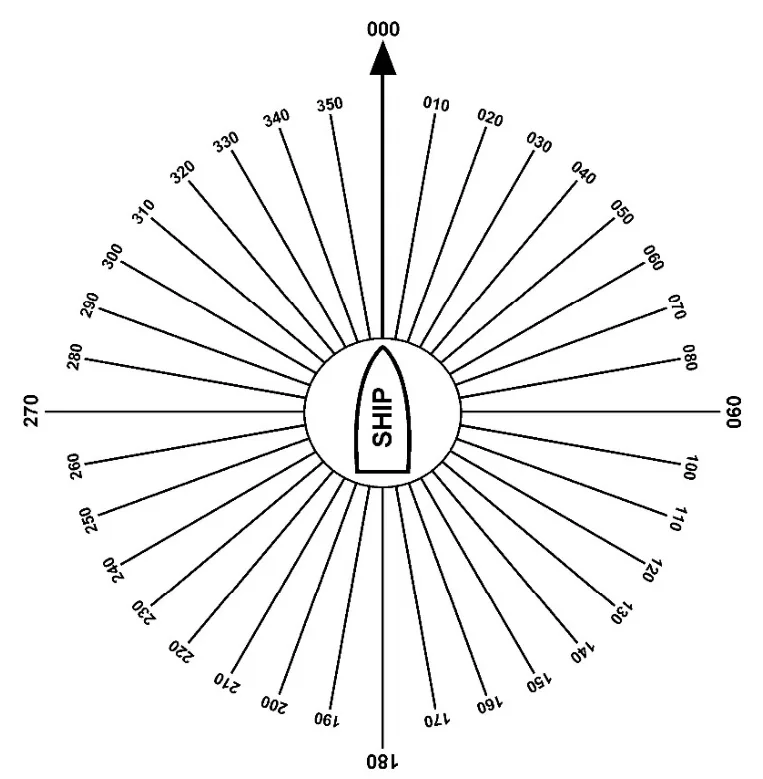
Lookouts make reports using relative bearings only. The relative bearing of another object depends on its location in relation to the vessel’s hull. They start off with 000°, which is straight off the bow or dead ahead. The bearings increase moving clockwise around the vessel all the way to 359°. Straight out from the starboard beam of the vessel would be 090°, dead astern would be 180°, and straight out from the port beam of the vessel would be 270° (Figure 2-1).
Reporting Procedures
Quoted word for word — COMDTINST 16114.1B, ch. 2, D.8
The following procedures are important in reporting relative bearings:
| Step | Procedure |
| 1 | Study the diagram on major reference points of relative bearings. Picture in your mind the complete circle of relative bearings around the boat in 10° increments. |
| 2 | Bearings are always reported in three digits and distinctly spoken digit by digit. To ensure one number is not mistaken for another, the following pronunciation is required: Numeral spoken as Numeral spoken as 0 ZE-ROH 5 FIFE 1 WUN 6 SIX 2 TOO 7 SEV-UN 3 TREE 8 AIT 4 FOW-ER 9 NINE-ER |
| 3 | The following procedures are important in reporting relative bearings: Bearing Reported as 000° ZE-ROH ZE-ROH ZE-ROH 010° ZE-ROH WUN ZE-ROH 045° ZE-ROH FOW-ER FIFE 090° ZE-ROH NINE-ER ZE-ROH 135° WUN TREE FIFE 180° WUN AIT ZE-ROH 225° TOO TOO FIFE 260° TOO SIX ZE-ROH 270° TOO SEV-UN ZE-ROH 315° TREE WUN FIFE |
| Numeral spoken as | Numeral spoken as | ||
| 0 ZE-ROH | 5 | FIFE | |
| 1 WUN | 6 | SIX | |
| 2 TOO | 7 | SEV-UN | |
| 3 TREE | 8 | AIT | |
| 4 FOW-ER | 9 | NINE-ER |
| Bearing | Reported as |
| 000° | ZE-ROH ZE-ROH ZE-ROH |
| 010° | ZE-ROH WUN ZE-ROH |
| 045° | ZE-ROH FOW-ER FIFE |
| 090° | ZE-ROH NINE-ER ZE-ROH |
| 135° | WUN TREE FIFE |
| 180° | WUN AIT ZE-ROH |
| 225° | TOO TOO FIFE |
| 260° | TOO SIX ZE-ROH |
| 270° | TOO SEV-UN ZE-ROH |
| 315° | TREE WUN FIFE |
Position Angle
Quoted word for word — COMDTINST 16114.1B, ch. 2, D.9
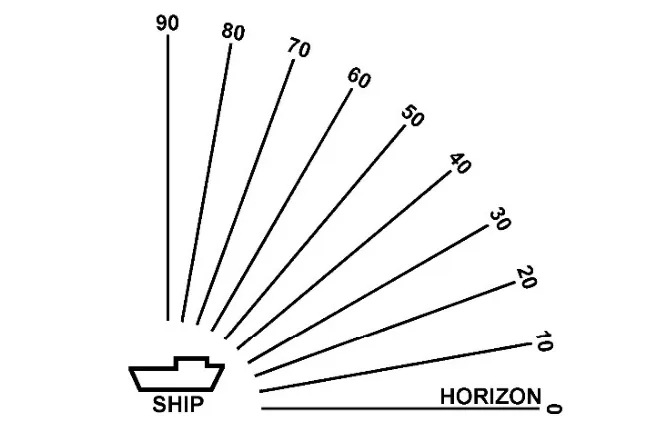
Objects in the sky are located by their relative bearing and position angle. The position angle of an aircraft is its height in degrees above the horizon as seen from the boat. The horizon is 0° and directly overhead is 90° or “Zenith.” The position angle can never be more than 90°. Position angles are reported in one or two digits and the word “Position Angle” is always spoken before the numerals (Figure 2-2).
Distance
Quoted word for word — COMDTINST 16114.1B, ch. 2, D.10
Report distances in yards. Knowing the distance to the horizon, land, or other reference point, will help estimate distance. Dividing the distance from the starting point to the point of reference, provides an estimate of the distance to another object. Ranges in yards are reported digit by digit, except when reporting yards in hundreds or thousands, which are spoken as listed below:
| Number of Yards | Spoken as |
| 50 | FIFE ZE-ROH |
| 500 | FIFE HUNDRED |
| 5000 | FIFE THOUSAND |
Making Reports
Quoted word for word — COMDTINST 16114.1B, ch. 2, D.11
When making reports, the lookout names or provides a description of the object sighted, the direction (in relative degrees), the position angle (if an air contact), and the range to the object (in yards) are required and must be reported in the following format: (01) Object name or description. (02) Bearing. (03) Position Angle (air contact only). (04) Range. For example: Discolored water on a bearing of 340° relative to the bow of the boat and at a distance of 2,000 yards. Reported as: “Discolored water Bearing TREE- FOW-ER ZE-ROH, Range TOO THOUSAND”. An aircraft bearing 280° relative to the bow of the ship, 30° above the horizon, and at a distance of 9,000 yards. Reported as: “Aircraft Bearing TOO AIT ZE-ROH, Position Angle TREE ZE-ROH, Range NINE-ER THOUSAND”.
Scanning
Quoted word for word — COMDTINST 16114.1B, ch. 2, D.12
The lookout’s method of eye search is called scanning. Scanning is a step- by-step method of visually searching for objects. Good scanning techniques will ensure that objects are not missed. Scanning also reduces eye fatigue. Development of a systematic scanning technique is important. There are two common scanning methods: (01) Left to right and back again. (02) Top to bottom and bottom to top. In either case, move eyes in increments. This creates overlaps in field of vision and fewer objects will be missed.
| Step | Procedure | |
| 1 | When looking for an object, scan the sky, sea, and horizon slowly and regularly. Scan from left-to-right and back again or from top-to-bottom and bottom-to-top. | |
| 2 | When scanning, do not look directly at the horizon; look above it. Move head from side to side and keep eyes fixed. This will give any stationary objects in the field of vision the appearance of moving and make them easier to see. One technique is to scan in small steps of about 10° and have them slightly overlap while moving across the field of view. | |
| 3 | Fatigue, boredom, and environmental conditions affect scanning. For example, after prolonged scanning, with little or no contrast, the eyes develop a tendency to focus short of where the person is looking. To prevent this, periodically focus on a close object such as whitecaps or the bow of the boat. |
NOTE
For more details on scanning, refer to Reference (l).
Fog Scanning
Quoted word for word — COMDTINST 16114.1B, ch. 2, D.13
Early detection in fog is vital because a contact might be heard long before it’s seen. Early detection is vital. Since the fog reduces visual distance, binoculars are not recommended. It is better to have a wide field of vision than a narrow magnified one. It is also important to position the lookout where they will not be hindered by background noise and other distractions. Usually the bow is best, if conditions allow. In severe fog, a second designated lookout should be stationed to cover the aft portion of the vessel. Designated lookout should make use of all available equipment, including thermal imaging devices, which will assist in the assignment.
Night Lookout Watch
Description
Quoted word for word — COMDTINST 16114.1B, ch. 2, D.14
Although the duties for day and night lookout are the same, safety and caution during night watches are especially important. Though it might be easier to acquire a contact on the horizon at night because of its navigation lights, it’s obviously more difficult to pick up unlighted objects such as rocks, shoals, and buoys. Eyes respond more slowly at night and have a harder time picking up fixed objects than moving objects.
Guidelines
Quoted word for word — COMDTINST 16114.1B, ch. 2, D.15
The guidelines for lookout watches also apply for night lookout watches.
Dark Adaptation
Quoted word for word — COMDTINST 16114.1B, ch. 2, D.16
Going from a brightly lit room to a very dark room initially decreases vision. As time in the darkness increases, vision improves and things that were not visible on the initial point of entry are now clear. As eyes adjust to the weak light, vision gradually improves. This is called dark adaptation. Before operating in dark conditions, it is recommended to prepare by moving into a dark environment or wearing goggles equipped with red lenses for 30 minutes prior to getting underway. Care should be taken not to expose eyes to bright lights once they are adjusted. Even a quick flash of light can destroy night vision. Chart and cabin lights, as well as flashlights, should be equipped with red filters to ensure night vision is maintained while underway.
NOTE
Avoid looking at bright lights during nighttime operations. When a light must be used, use a red light. Avoid using flash cameras or mobile phones with flash capabilities.
Night Scanning
Quoted word for word — COMDTINST 16114.1B, ch. 2, D.17
As a night lookout, scan the horizon in a series of small sectors allowing eyes to adjust to each. When looking at an object, look all around it, not directly at it. This “off-center vision” allows the object to be seen clearer than trying to stare directly at it. Once located, use binoculars to assist with identification. The use of electronic night vision equipment is highly recommended for early detection.
Night Fog
Quoted word for word — COMDTINST 16114.1B, ch. 2, D.18
In night time fog conditions, any source of light (navigation lights) will reflect back off the fog and reduce night vision. This effect will reduce the lookout’s ability to detect contacts in various sectors surrounding the boat. Extra care should be used when operating at night in the fog. The use of spotlights is not recommended unless identifying objects that are within close range.
Night Vision Devices (AN/PVS- 14 MNVD)
Quoted word for word — COMDTINST 16114.1B, ch. 2, D.19
The AN/PVS-14 Monocular Night Vision Device (MNVD) is the current Coast Guard-issued nighttime detection equipment available to our boat community. Night vision devices improve the user’s visual acuity while operating in environments with negligible ambient lighting. The AN/VPS- 14 is the all around best multi functional night vision monocular available to our multi-mission platforms. The image area viewed through night vision devices is most pronounced under low light conditions. Seeing it is an indicator that supplemental illumination is needed. Under most conditions, an infrared (IR) light source is preferable to a visible light source and may be provided by a flashlight with an IR filter, handheld IR illuminators and spotlights, IR chemlights, etc. Crews should employ supplemental IR illumination to the maximum extent possible, especially if search targets may be wearing highly reflective material, such as the reflective tape of a PFD.
NOTE
When using night vision, the eye adjusts to the light output of the eyepiece. When removed, the vision will be limited in the eye that was night-vision aided. It will normally take at least two minutes to regain total, unaided dark-adapted vision.
NOTE
Use extreme caution when considering the use of an IR light source as it will indicate your position to anyone else using night vision devices. Night vision devices provide a 40 degree field of view, which is substantially less than the normal peripheral vision of 190 degrees. This means that when you're wearing the night vision device, you're unable to see things to your far left or right, or above or below, the direction you're looking. Use of monocular devices rather than binocular systems help, as vision in one eye is less affected and you do not lose peripheral vision on the side of the unaided eye. Regardless the system in use, it is critical to constantly scan to maintain awareness of the surroundings. Because night vision provides the eye a flat two-dimensional picture tube (called a phosphor screen), depth perception will be affected. Time spent training with the equipment will help the brain compensate for this. Night vision devices cannot see the colors normally seen. Because night vision devices are more sensitive to red and white lights, they will appear brighter and sometimes closer. For this reason, the apparent brightness of a light should not be used as an estimate for the distance to the light. A halo may be visible around some lights and obscure the area around the light source. Reducing brightness on variable gain equipped units may reduce the halo. Image intensification is not designed to see through fog, smoke, heavy rain, or snowfall, which reflect ambient light. Using supplemental IR illumination will only make it more difficult to see.
NOTE
Additional information can be found in Commandant Instruction 1543.3, Personnel Qualification Standard (PQS) – AN\PVS 14 Monocular Night Vision Device (MNVD).
Thermal Imaging Devices
Quoted word for word — COMDTINST 16114.1B, ch. 2, D.20
A thermal imaging device can aid in the safe navigation of a boat. When used properly, a thermal imaging device can not only increase mission safety but also mission success by displaying an electronic image of an object’s heat signature. A thermal imaging device can enhance visibility, allowing an experienced boat crew to identify hazards along their course such as unlit buoys or day beacons as well as poorly or unlit vessels.. Even with the advantage of a thermal imaging device, crews should always maintain a safe speed to avoid collisions.
Basic Operating Principle
Quoted word for word — COMDTINST 16114.1B, ch. 2, D.20.a
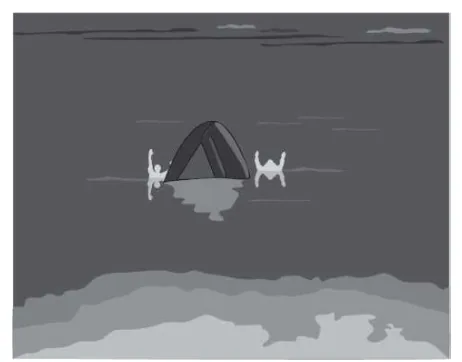
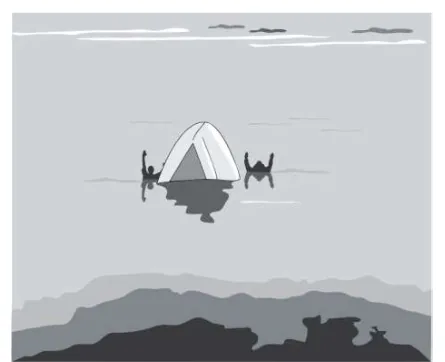
Infrared radiation is emitted from every object, even ice. A thermal imaging device uses specialized sensors to capture and display the “heat energy” on a monitor which allows a user to view the differences of infrared radiation emitted from objects in the camera view. The thermal imaging device does not measure how much heat is in an object; rather it is showing the amount of heat an object emits, relative to other objects in view. The clarity of the displayed image is a function of the settings used, when compared to other objects, the picture of what you are viewing is usually quite clear. For example, a person in the water emits more heat than the water.
Display Options
Quoted word for word — COMDTINST 16114.1B, ch. 2, D.20.b
Most thermal imaging devices have several types of image displays. The two most common types of image displays are: (01) White Hot – Images reflecting more heat are white, (02) Black Hot – Images reflecting more heat are black.
No Light Environments
Quoted word for word — COMDTINST 16114.1B, ch. 2, D.20.c
Thermal imaging devices differ from night vision devices because night vision devices amplify the light available to increase visibility, whereas, a thermal imaging device detects infrared radiation emitted from objects and requires no light. This is a distinct advantage when underway and there is no light.
Range
Quoted word for word — COMDTINST 16114.1B, ch. 2, D.20.d
The range of a thermal imaging device is limited, much like a camera. It will not take pictures around the corner, it will not take pictures “through” items and it will not show items beyond the horizon. It is line of sight only. Even if a contact can be seen 5 miles away, the image on the screen may not show that contact with much detail, if at all. Understanding this limitation is essential.
Weather
Quoted word for word — COMDTINST 16114.1B, ch. 2, D.20.e
The image displayed can be affected by the weather. Most times there is sufficient contrast between the different objects on the screen, however, there are times when due to certain environmental factors, the image contrast isn’t as clear. This can occur in the early morning or when it has been a foggy day. This is because objects have not had a chance to absorb the sun’s energy throughout the day and radiate the heat energy back into the atmosphere (this is what shows the differences on the screen). The picture will still show objects but the differences in color may be subtle. Frequent exposure and training to these subtle differences allow a crew to interpret these images. Additionally, while you can see the heat energy of objects in the fog, it does limit the range in which you are able to see.
Helmsman
Description
Quoted word for word — COMDTINST 16114.1B, ch. 2, D.21
The helmsman is responsible for the following: (01) Safely steering the boat. (02) Maintaining a course. (03) Carrying out all helm commands given by the coxswain. The helmsman role can be carried out by the coxswain or by any designated crew member. Every crew member should learn to steer and control the boat. They must be able to maneuver the boat using both the primary and emergency steering systems (if equipped) as well as the engine(s).
Guidelines
Quoted word for word — COMDTINST 16114.1B, ch. 2, D.22
There are several guidelines when a boat uses a helmsman: (01) Check with the coxswain for any special instructions and for the course to be steered. (02) Repeat all commands given by the coxswain. (03) Execute all commands given by the coxswain. (04) Maintain a given course within ±5° of ordered course. (05) Remain at the helm until properly relieved. (06) Execute maneuvers only when expressly ordered, however, minor changes in heading to avoid debris, which could damage propeller or rudders, are essential. (07) Operate the emergency tiller (if equipped) during loss of steering. (08) Properly inform relief of all pertinent information.
Anchor Watch
Description
Quoted word for word — COMDTINST 16114.1B, ch. 2, D.23
An anchor watch is set when the boat is at anchor. The person on watch must ensure that the anchor line does not chafe and that the anchor does not drag. The individual on watch also looks for other vessels in the area. Even when the boat is anchored, there is the possibility that it can be hit by another boat. For more information on anchoring procedures, see Reference (k).
Guidelines
Quoted word for word — COMDTINST 16114.1B, ch. 2, D.24
The following guidelines should be used when standing anchor watch: (01) Check the strain on the anchor line frequently. (02) Check that the anchor line is not chafing. (03) Confirm the position of the boat at least every 15 minutes, or at shorter intervals as directed by the coxswain. (04) Report bearing or range (distance) changes to the coxswain immediately. (05) Report approaching vessels to the coxswain immediately. (06) Report major changes in wind velocity or direction. (07) Check for current or tidal changes. (08) Report any unusual conditions.
Checking for Chafing
Quoted word for word — COMDTINST 16114.1B, ch. 2, D.25
Once the anchor is set, chafing gear should be applied to the anchor line. It is the job of the anchor watch to ensure chafing gear stays in place and the anchor line does not chafe through.
Checking for Dragging
Quoted word for word — COMDTINST 16114.1B, ch. 2, D.26
There are two methods to determine if the anchor is dragging: (01) Check for tension on the anchor line. (02) Check the boat’s position. If the anchor is dragging over the bottom, sometimes vibration can be felt in the line. The boat’s position should be periodically checked by taking a navigational fix. Both methods above should always be used.
Checking Position
Quoted word for word — COMDTINST 16114.1B, ch. 2, D.27
It is important to routinely check the boat’s position to ensure it is not drifting or dragging anchor: (01) On a GPS equipped boat, note the boat’s position or set the anchor alarm, if equipped. Any change in position or audible alarm would indicate the boat’s position is changing. (02) On a boat equipped with radar, determine the distance (range) to three points of land on the radar screen. Any change in the ranges may indicate anchor drag. (03) Take compass bearings to three separate objects spread at least 45° apart. Any bearing changes may indicate that the boat is beginning to drift. (04) Make a note of each time the bearings or ranges are checked. Also note the boat’s position and the depth of water regularly. If the water depth or position changes, the anchor may be dragging. As the wind or water current changes direction, the boat will swing about its anchor. This swing circle is centered on the position of the anchor. The swing circle’s radius is equal to the boat’s length plus the length of anchor line/chain that has veered (Example: 40-foot boat + 150 feet of anchor line out = 190-foot swing circle). The swing circle must be clear of other vessels and underwater obstructions. When checking the boat’s position, it should fall inside the swing circle.
Towing Watch
Towing Watch
Quoted word for word — COMDTINST 16114.1B, ch. 2, D.28
A towing watch is normally performed aft on the boat. The primary duty of the towing watch is to keep the towline and the boat being towed under constant observation.
Tow Watch Guidelines
Quoted word for word — COMDTINST 16114.1B, ch. 2, D.29
The guidelines for standing this watch are as follows: (01) Report any unusual conditions, equipment failure, or problems to the coxswain immediately. (02) Observe how the tow is riding (e.g., in step, listing, or yawing). (03) Ensure chafing gear is riding in place. (04) Adjust the scope of the towline upon command of the coxswain. (05) Keep deck space area clear of unnecessary gear and people. (06) Stay clear of the immediate area around the towline due to possible line snap back. (07) Know when and how to do an emergency breakaway.
Observed
Quoted word for word — COMDTINST 16114.1B, ch. 2, D.30
The towing watch must be aware of and report any signs of danger. Many
Danger
of the signs of danger include: (01) Yawing - disabled boat veers from one side to the other which may cause one or both boats to capsize. (02) List increasing on towed boat. (03) Boats out of step – When both boats are not on the crest or in the trough of the seas at the same time potentially causing undo strain on the towline. (04) Towed boat taking on water. (05) Deck hardware failure due to stress, no backing plates, etc. (06) Towline about to part due to stress, chafing, or other damage. (07) Towed boat overtaking boat due to sudden reduction in speed. (08) Positioning of towed boat’s crew/waving of arms. (09) Slack tow line in the water that may foul propeller, rudder or waterjets.
Maintaining Watch
Quoted word for word — COMDTINST 16114.1B, ch. 2, D.31
A tow watch should be maintained until the disabled boat is moored or until relieved. When relieved, all important information should be passed to the relief (e.g., problems with chafing gear, towed boat yaws, etc.).
Fatigue
Quoted word for word — COMDTINST 16114.1B, ch. 2, E.1
Mental and physical fatigues are among the greatest dangers during rough weather operations. The hazard of fatigue dramatically reduces the powers of observation, concentration, and judgment. This reduces the ability to exert effort and increases the probability that prescribed safety precautions may be disregarded. The following are examples of situations that may cause fatigue: (01) Operating in extreme hot or cold weather conditions. (02) Eye strain from hours of looking through sea-spray blurred windshields. (03) The effort of holding on and maintaining balance. (04) Stress. (05) Exposure to noise. (06) Exposure to the sun. (07) Poor physical conditioning. (08) Lack of sleep. (09) Boredom.
Crew Responsibility
Quoted word for word — COMDTINST 16114.1B, ch. 2, E.2
The crew’s safety and welfare are the coxswain’s primary responsibility. Coxswains must be constantly aware of stress signs evident in their crews, learn to recognize fatigue, and take corrective action. Crewmembers must watch each other’s condition to prevent excessive fatigue from taking its toll. The ability of each member to respond to normal conversation and to complete routine tasks should be observed.
Symptoms
Quoted word for word — COMDTINST 16114.1B, ch. 2, E.3
The primary symptoms of fatigue are: (01) Inability to focus or concentrate/narrowed attention span. (02) Mental confusion or judgment error. (03) Decreased coordination of motor skills and sensory ability (hearing, seeing). (04) Increased irritability. (05) Decreased performance. (06) Decreased concern for safety. Any one of these symptoms can cause mistakes in judgment or cause taking shortcuts that could threaten the safety of the mission and crew. It is important to ward off the effects of fatigue before it gets too great. Fatigue can lead to faulty decisions and a “don’t care” type of attitude.
Prevention
Quoted word for word — COMDTINST 16114.1B, ch. 2, E.4
Coxswains must be aware of the dangers that exist when crewmembers push themselves beyond reasonable limits of performance. They should help eliminate mistakes caused by fatigue. Coxswains must not hesitate to call for assistance when fatigue begins to impair the efficiency of their crew. Some preventive measures are: (01) Adequate rest. (02) Appropriate dress for weather conditions. (03) Rotating crew duties. (04) Providing food and refreshments suitable for conditions. (05) Observing other crewmembers for signs of fatigue.
Environmental Conditions
Quoted word for word — COMDTINST 16114.1B, ch. 2, E.5
Despite the normal operating climate in a particular area, all crewmembers must dress for the prevailing weather. Keeping warm in cold weather and cool in hot weather helps prevent fatigue. Some other environmental conditions that also promote fatigue are: (01) Motion sickness, (02) Glare from the sun, (03) Wind and rough sea conditions, (04) Fog, Rain or snow, (05) Vibration and sound (boat engine).
NOTE
Information on Boat Crew Fatigue Standards may be found in Reference (a).
Prescription Drugs
Quoted word for word — COMDTINST 16114.1B, ch. 2, F.1
Prescription drugs have the ability to impair or incapacitate crewmembers. Certain medications can be as incapacitating as alcohol. In addition, many medications, if taken with alcohol, accentuate the action of both. Crewmembers should always notify the command while taking prescription drugs which may affect performance or prevent performance of duties.
Alcohol
Quoted word for word — COMDTINST 16114.1B, ch. 2, F.2
Alcohol is a well recognized central nervous system depressant and is one of the most frequently used and abused drugs in our society. Even small amounts of alcohol in the blood can seriously impair judgment, reaction time, and muscular control, and reduce the restorative effects of sleep. The level of alcohol in the body varies with the frequency and amount of alcohol intake, the length of time following cessation of drinking and an individual’s body weight. A zero alcohol level is essential for boat crew personnel to meet the rigorous demands of boat operations. Detectable blood alcohol or symptomatic hangovers are usually causes for restricting boat crew personnel from operations. Personnel in a duty status shall not consume alcohol for a minimum 12 hours prior to assuming duty. This time span allows an adequate margin of safety before resuming operations.
Tobacco
Quoted word for word — COMDTINST 16114.1B, ch. 2, F.3
The nicotine contained in tobacco is a quick-acting poison. Excessive smoking causes depression of the nervous system and impairment of vision. The carbon monoxide resulting from the combustion of tobacco is absorbed by the bloodstream in preference to oxygen, resulting in a lowering of altitude tolerance. Tobacco smoke also irritates the respiratory system.
Caffeine
Quoted word for word — COMDTINST 16114.1B, ch. 2, F.4
The drug caffeine, contained in coffee, energy drinks, tea, and many soft drinks, can produce an adverse effect on the body. The amount of caffeine contained in just two cups of coffee or one energy drink appreciably affects the rates of blood-flow and respiration. In small amounts, coffee and energy drinks can be considered nervous system stimulants. Excessive amounts may produce nervousness, inability to concentrate, headaches, and dizziness. Individuals accustomed to daily intake of caffeine may develop headaches and experience a loss of sharpness if daily intake is stopped or significantly curtailed.
Flash cards
46 CFR 184, § 184.100(a) — General requirement. What does it provide?
(a) Vessel control systems and other miscellaneous systems and equipment required by this part must be suitable for the purposes intended.
46 CFR 184, § 184.100(a)
46 CFR 184, § 184.100(b) — General requirement. What does it provide?
(b) The cognizant Officer in Charge, Marine Inspection (OCMI) may require navigation, control, or communications equipment, in excess of the equipment specifically required by this part, on a vessel that is of a novel design, operates at high speeds in restricted or high traffic areas, operates in a dynamically supported mode, or operates on extended routes or in remote locations.
46 CFR 184, § 184.100(b)
46 CFR 184, § 184.115(a) — Applicability to existing vessels. What does it provide?
(a) An existing vessel need not comply with §§ 184.402(c), 184.404, 184.410, and 184.602 unless the cognizant OCMI specifically requires compliance due to the route or service of the vessel.
46 CFR 184, § 184.115(a)
46 CFR 184, § 184.115(b) — Applicability to existing vessels. What does it provide?
(b) An existing vessel need not comply with the requirements of § 184.610 until March 11, 2001, or 10 years after its keel was laid or the vessel was at a similar stage of construction, whichever is later.
46 CFR 184, § 184.115(b)
46 CFR 184, § 184.115(c) — Applicability to existing vessels. What does it provide?
(c) An existing vessel need not comply with the requirements of § 184.710 until March 11, 1997.
46 CFR 184, § 184.115(c)
46 CFR 184, § 184.200 — General. What does it provide?
Cooking and heating equipment must be suitable for marine use. Equipment designed and installed in accordance with American Boat and Yacht Council (ABYC) A-3, “Galley Stoves,” and A-7, “Boat Heating Systems,” or with National Fire Protection Association (NFPA) 302, “Pleasure and Commercial Motor Craft,” complies with this requirement, except as restricted by § 184.202 of this part.
46 CFR 184, § 184.200
46 CFR 184, § 184.202(a) — Restrictions. What does it provide?
(a) The use of gasoline for cooking, heating, or lighting is prohibited on all vessels.
46 CFR 184, § 184.202(a)
46 CFR 184, § 184.202(b) — Restrictions. What does it provide?
(b) Fireplaces or other space heating equipment with open flames are prohibited from being used on all vessels.
46 CFR 184, § 184.202(b)
46 CFR 184, § 184.202(c) — Restrictions. What does it provide?
(c) Vessels permitted to use liquefied and non-liquefied gases as cooking fuels by 46 CFR part 147 must meet the requirements in § 184.240 of this part. The use of these fuels for cooking, heating, and lighting on ferry vessels is prohibited by part 147 in subchapter N of this chapter.
46 CFR 184, § 184.202(c)
46 CFR 184, § 184.210(a) — Heating equipment. What does it provide?
(a) Each heater must be so constructed and installed as to prevent contact with combustible materials such as towels and clothing.
46 CFR 184, § 184.210(a)
46 CFR 184, § 184.210(b) — Heating equipment. What does it provide?
(b) Each electric space heater must be provided with a thermal cutout to prevent overheating.
46 CFR 184, § 184.210(b)
46 CFR 184, § 184.210(c) — Heating equipment. What does it provide?
(c) Each heater element of an electric space heater must be of an enclosed type, and the element case or jacket must be made of a corrosion resistant material.
46 CFR 184, § 184.210(c)
46 CFR 184, § 184.220(a) — Cooking equipment. What does it provide?
(a) Doors on a cooking appliance must be provided with hinges and locking devices to prevent accidental opening in heavy seas.
46 CFR 184, § 184.220(a)
46 CFR 184, § 184.220(b) — Cooking equipment. What does it provide?
(b) A cooking appliance must be installed to prevent movement in heavy seas.
46 CFR 184, § 184.220(b)
46 CFR 184, § 184.220(c) — Cooking equipment. What does it provide?
(c) For a grill or similar type of cooking appliance, means must be provided to collect grease or fat and to prevent its spillage on wiring or the deck.
46 CFR 184, § 184.220(c)
46 CFR 184, § 184.220(d) — Cooking equipment. What does it provide?
(d) Grab rails must be installed on a cooking appliance when determined by the cognizant OCMI to be necessary for safety.
46 CFR 184, § 184.220(d)
46 CFR 184, § 184.220(e) — Cooking equipment. What does it provide?
(e) Sea rails, with suitable barriers to prevent accidental movement of cooking pots, must be installed on a cooking range.
46 CFR 184, § 184.220(e)
46 CFR 184, § 184.220(f) — Cooking equipment. What does it provide?
(f) Electric connections for a cooking appliance must be dripproof.
46 CFR 184, § 184.220(f)
46 CFR 184, § 184.240 — Gas systems. What does it provide?
Cooking systems using liquefied petroleum gas (LPG) and compressed natural gas (CNG) must meet the following requirements:
46 CFR 184, § 184.240
46 CFR 184, § 184.240(a) — Gas systems. What does it provide?
(a) The design, installation and testing of each LPG system must meet ABYC A-1, “Marine Liquefied Petroleum Gas (LPG) Systems,” Chapter 6 of NFPA 302, or other standard specified by the Commandant.
46 CFR 184, § 184.240(a)
46 CFR 184, § 184.240(b) — Gas systems. What does it provide?
(b) The design, installation and testing of each CNG system must meet ABYC A-22, “Marine Compressed Natural Gas (CNG) Systems,” Chapter 6 of NFPA 302, or other standard specified by the Commandant.
46 CFR 184, § 184.240(b)
46 CFR 184, § 184.240(c) — Gas systems. What does it provide?
(c) Cooking systems using Chapter 6 of NFPA 302 as the standard must meet the following additional requirements:
(1) The storage or use of CNG containers within the accommodation area, machinery spaces, bilges, or other enclosed spaces is prohibited;
(2) LPG or CNG must be odorized in accordance with ABYC A-1 appendix 4 or A-22 appendix 4, respectively;
(3) The marking and mounting of LPG cylinders must be in accordance with ABYC A-1 appendix 7; and
(4) LPG cylinders must be of the vapor withdrawal type as specified in ABYC A-1 section 1.7.
46 CFR 184, § 184.240(c)
46 CFR 184, § 184.240(d) — Gas systems. What does it provide?
(d) Continuous pilot lights or automatic glow plugs are prohibited for an LGP or CNG installation using ABYC A-1 or A-22 as the standard.
46 CFR 184, § 184.240(d)
46 CFR 184, § 184.240(e) — Gas systems. What does it provide?
(e) CNG installation using ABYC A-22 as the standard must meet the following additional requirements:
(1) The storage or use of CNG containers within the accommodation area, machinery spaces, bilges, or other enclosed spaces is prohibited;
(2) CNG cylinders, regulating equipment, and safety equipment must meet the installation, stowage, and testing requirements of paragraph 6-5.12 of NFPA 302.
(3) The use or stowage of stoves with attached CNG cylinders is prohibited as specified in paragraph 6-5.1 of NFPA 302.
46 CFR 184, § 184.240(e)
46 CFR 184, § 184.240(f) — Gas systems. What does it provide?
(f) If the fuel supply line of an LPG or CNG system enters an enclosed space on the vessel, a remote shutoff valve must be installed that can be operated from a position adjacent to the appliance. The valve must be located between the fuel tank and the point where the fuel supply line enters the enclosed portion of the vessel. A power operated valve installed to meet this requirement must be of a type that will fail closed.
46 CFR 184, § 184.240(f)
46 CFR 184, § 184.240(g) — Gas systems. What does it provide?
(g) The following variances from ABYC A-1 section 1.12 are allowed for CNG:
(1) The storage locker or housing access opening need not be in the top.
(2) The locker or housing need not be above the waterline.
46 CFR 184, § 184.240(g)
46 CFR 184, § 184.240(h) — Gas systems. What does it provide?
(h) The following variances from NFPA 302 are allowed:
(1) The storage locker or housing for CNG tank installations need not be above the waterline as required by paragraph 6-5.12.1.1(a);
(2) Ignition protection need not be provided as required by paragraph 6-5.4.
Note to § 184.240:
The ABYC and NFPA standards referenced in this section require the posting of placards containing safety precautions for gas cooking systems.
46 CFR 184, § 184.240(h)
46 CFR 184, § 184.402(a) — Compasses. What does it provide?
(a) Except as otherwise provided in this section every vessel must be fitted with a suitable magnetic compass designed for marine use, to be mounted at the primary operating station.
46 CFR 184, § 184.402(a)
46 CFR 184, § 184.402(b) — Compasses. What does it provide?
(b) The following vessels need not be fitted with a compass:
(1) A vessel on a rivers route;
(2) A non-self propelled vessel; and
(3) A vessel operating on short restricted routes on lakes, bays, and sounds.
46 CFR 184, § 184.402(b)
46 CFR 184, § 184.402(c) — Compasses. What does it provide?
(c) Except on a vessel limited to daytime operations, the compass must be illuminated.
46 CFR 184, § 184.402(c)
46 CFR 184, § 184.404(a) — Radars. What does it provide?
(a) A vessel must be fitted with a Federal Communications Commission (FCC) type accepted general marine radar system for surface navigation with a radar screen mounted at the primary operating station if:
(1) The vessel is self-propelled;
(2) The vessel has an oceans, coastwise, limited coastwise, or Great Lakes route; and
(3) The vessel carries more than 49 passengers.
46 CFR 184, § 184.404(a)
46 CFR 184, § 184.404(b) — Radars. What does it provide?
(b) A ferry that carries more than 49 passengers on a rivers route not within one mile of land must be fitted with a FCC Type Accepted general marine radar system for surface navigation with a radar screen mounted at the primary operating station.
46 CFR 184, § 184.404(b)
46 CFR 184, § 184.404(c) — Radars. What does it provide?
(c) The radar and its installation must be suitable for the intended speed and route of the vessel.
46 CFR 184, § 184.404(c)
46 CFR 184, § 184.404(d) — Radars. What does it provide?
(d) A vessel operated on a short restricted route need not be fitted with a radar if the cognizant OCMI determines that a radar is not necessary due to the vessel's route and local weather conditions.
46 CFR 184, § 184.404(d)
46 CFR 184, § 184.410 — Electronic position fixing devices. What does it provide?
A vessel on an oceans route must be equipped with an electronic position fixing device, capable of providing accurate fixes for the area in which the vessel operates, to the satisfaction of the cognizant OCMI.
46 CFR 184, § 184.410
46 CFR 184, § 184.420(a) — Charts and nautical publications. What does it provide?
(a) As appropriate for the intended voyage, a vessel must carry adequate and up-to-date:
(1) Charts of large enough scale to make safe navigation possible;
(2) U.S. Coast Pilot or similar publication;
(3) Coast Guard Light List;
(4) Tide tables; and
(5) Current tables, or a river current publication issued by the U.S. Army Corps of Engineers or a river authority.
46 CFR 184, § 184.420(a)
46 CFR 184, § 184.420(b) — Charts and nautical publications. What does it provide?
(b) Extracts from the publications listed above for the areas to be transited may be provided instead of the complete publication.
46 CFR 184, § 184.420(b)
46 CFR 184, § 184.620(a) — Propulsion engine control systems. What does it provide?
(a) A vessel must have two independent means of controlling each propulsion engine. Control must be provided for the engine speed, direction of shaft rotation, and engine shutdown.
(1) One of the means may be the ability to readily disconnect the remote engine control linkage to permit local operation.
(2) A multiple engine vessel with independent remote propulsion control for each engine need not have a second means of controlling each engine.
46 CFR 184, § 184.620(a)
46 CFR 184, § 184.620(b) — Propulsion engine control systems. What does it provide?
(b) In addition to the requirements of paragraph (a), a vessel must have a reliable means for shutting down a propulsion engine, at the main pilothouse control station, which is independent of the engine's speed control.
46 CFR 184, § 184.620(b)
46 CFR 184, § 184.620(c) — Propulsion engine control systems. What does it provide?
(c) A propulsion engine control system, including pilothouse control, must be designed so that a loss of power to the control system does not result in an increase in shaft speed or propeller pitch.
46 CFR 184, § 184.620(c)
46 CFR 184, § 184.710 — First-aid kits. What does it provide?
A vessel must carry either a first-aid kit that meets the requirements in 46 CFR 199.175(b)(10) or a kit with equivalent contents and instructions. For equivalent kits, the contents must be stowed in a suitable, watertight container that is marked “First-Aid Kit”. A first-aid kit must be easily visible and readily available to the crew.
46 CFR 184, § 184.710
46 CFR 185, § 185.100 — General requirement. What does it provide?
A vessel must be operated in accordance with applicable laws and regulations and in such a manner as to afford adequate precaution against hazards that might endanger the vessel and the persons being transported.
46 CFR 185, § 185.100
46 CFR 185, § 185.115(a) — Applicability; preemptive effect. What does it provide?
(a) An existing vessel need not comply with the hull marking requirements in § 185.602(c) until completion of a vessel's first drydock required by § 176.600 of this subchapter, which occurs after March 11, 1996.
46 CFR 185, § 185.115(a)
46 CFR 185, § 185.115(b) — Applicability; preemptive effect. What does it provide?
(b) An existing vessel need not comply with the marking requirement in §§ 185.604 and 185.610, where the size and contents of the markings required by these sections vary from the size and contents of required markings on lifesaving equipment, watertight doors, and watertight hatches on the vessel prior to March 11, 1996, until the existing markings are no longer legible as determined by the cognizant Officer in Charge, Marine Inspection (OCMI).
46 CFR 185, § 185.115(b)
46 CFR 185, § 185.115(c) — Applicability; preemptive effect. What does it provide?
(c) An existing vessel need not comply with the requirements of §§ 185.514, 185.516, and 185.604(i) until completion of the first inspection for certification that occurs after March 11, 1996.
46 CFR 185, § 185.115(c)
46 CFR 185, § 185.115(d) — Applicability; preemptive effect. What does it provide?
(d) The regulations in this part have preemptive effect over State or local regulations in the same field.
46 CFR 185, § 185.115(d)
46 CFR 185, § 185.304(a) — Navigation underway. What does it provide?
(a) The movement of vessel shall be under the direction and control of the master or a licensed mate at all times. The master shall operate the vessel keeping the safety of the passengers and crew foremost in mind by directing the vessel in order to prevent a casualty. Special attention should be paid to:
(1) The current(s) velocity and direction of the transiting area;
(2) Tidal state;
(3) Prevailing and forecasted visibility and environmental conditions, including wind and waves;
(4) Density of marine traffic;
(5) Potential damage caused by own wake;
(6) The danger of each closing visual or radar contact;
(7) Vessel's handling characteristics; and
(8) Magnetic variation and deviation errors of the compass.
46 CFR 185, § 185.304(a)
46 CFR 185, § 185.304(b) — Navigation underway. What does it provide?
(b) Masters of vessels not greater than 65 ft (19.8 m) in length must have means available, satisfactory to the Officer in Charge, Marine Inspection (OCMI), to obtain or monitor the latest marine broadcast in order to comply with the requirements of paragraph (a) of this section.
46 CFR 185, § 185.304(b)
46 CFR 185, § 185.315(a) — Verification of vessel compliance with applicable stability requirements. What does it provide?
(a) After loading and prior to departure and at all other times necessary to assure the safety of the vessel, the master shall determine that the vessel complies with all applicable stability requirements in the vessel's trim and stability book, stability letter, Certificate of Inspection, and Load Line Certificate, as the case may be. The vessel may not depart until it is in compliance with these requirements.
46 CFR 185, § 185.315(a)
46 CFR 185, § 185.315(b) — Verification of vessel compliance with applicable stability requirements. What does it provide?
(b) In order to fulfill the requirements of paragraph (a) of this section and avoid overloading the vessel, the master must take into account the total weight of passengers, crew, and variable loads.
46 CFR 185, § 185.315(b)
46 CFR 185, § 185.320 — Steering gear, controls, and communication system tests. What does it provide?
The master of a vessel shall have examined and tested the steering gear, signaling whistle, propulsion controls, and communication systems of the vessel prior to getting underway for a voyage, except that such examination and testing need not be conducted more than once in any 24 hour period.
46 CFR 185, § 185.320
46 CFR 185, § 185.330(a) — Hatches and other openings. What does it provide?
(a) Except when operating on lakes, bays, and sounds, or rivers routes in calm weather, all hatches and openings in the hull, except loading doors, of a vessel must be kept tightly closed except when being used.
46 CFR 185, § 185.330(a)
46 CFR 185, § 185.330(b) — Hatches and other openings. What does it provide?
(b) All watertight doors in subdivision bulkheads must be kept tightly closed during the navigation of the vessel except when being used for transit between compartments.
46 CFR 185, § 185.330(b)
46 CFR 185, § 185.335(a) — Loading doors. What does it provide?
(a) Except as allowed by paragraph (b) of this section, the master of a vessel fitted with loading doors shall assure that all loading doors are closed and secured during the entire voyage.
46 CFR 185, § 185.335(a)
46 CFR 185, § 185.335(b) — Loading doors. What does it provide?
(b) Loading doors, other than bow visors, may be opened when operating in protected or partially protected waters, provided the master of the vessel determines that the safety of the vessel is not impaired.
46 CFR 185, § 185.335(b)
46 CFR 185, § 185.335(c) — Loading doors. What does it provide?
(c) For the purpose of this section, “loading doors” include all weathertight ramps, bow visors, and openings used to load personnel, equipment, and stores, in the collision bulkhead, the side shell, and the boundaries of enclosed superstructures that are continuous with the shell of the vessel.
46 CFR 185, § 185.335(c)
46 CFR 185, § 185.340(a) — Vessels carrying vehicles. What does it provide?
(a) Automobiles or other vehicles must be stowed in such a manner as to permit both passengers and crew to get out and away from the vehicles freely in the event of fire or other disaster. The decks, where necessary, must be distinctly marked with painted lines to indicate the vehicle runways and the aisle spaces.
46 CFR 185, § 185.340(a)
46 CFR 185, § 185.340(b) — Vessels carrying vehicles. What does it provide?
(b) The master shall take any necessary precautions to see that automobiles or other vehicles have their motors turned off and their emergency brakes set when the vessel is underway, and that the motors are not started until the vessel is secured to the landing. In addition, a vehicle at each end of a line of vehicles or next to a loading ramp must have its wheels securely blocked, while the vessel is being navigated.
46 CFR 185, § 185.340(b)
46 CFR 185, § 185.340(c) — Vessels carrying vehicles. What does it provide?
(c) The master shall have appropriate “NO SMOKING” signs posted and shall take all necessary precautions to prevent smoking or carrying of lighted or smoldering pipes, cigars, cigarettes, or similar items in the deck area assigned to automobiles or other vehicles.
46 CFR 185, § 185.340(c)
46 CFR 185, § 185.340(d) — Vessels carrying vehicles. What does it provide?
(d) The master shall, prior to getting underway, ensure that vehicles are properly distributed consistent with the guidance in the vessel's stability letter and Certificate of Inspection, if applicable.
46 CFR 185, § 185.340(d)
46 CFR 185, § 185.350 — Fueling of vessels using fuel having a flash point of 43.3 °C (110 °F) or lower (such as gasoline). What does it provide?
A vessel must not take on fuel having a flash point of 43.3 °C (110 °F) or lower when passengers are on board.
46 CFR 185, § 185.350
46 CFR 185, § 185.352 — Ventilation of gasoline machinery spaces. What does it provide?
The mechanical exhaust for the ventilation of a gasoline machinery space, required by § 182.460(a)(1)(ii) of this chapter, must be operated prior to starting gasoline engines for the time sufficient to insure at least one complete change of air in the space served.
46 CFR 185, § 185.352
46 CFR 185, § 185.356 — Carriage of hazardous materials. What does it provide?
A vessel that transports a hazardous material, listed in 49 CFR 172.101, in commerce shall ensure the material is handled and transported in accordance with 49 CFR parts 171 and 176.
46 CFR 185, § 185.356
46 CFR 185, § 185.360 — Use of auto pilot. What does it provide?
Whenever an automatic pilot is used the master shall ensure that:
46 CFR 185, § 185.360
46 CFR 185, § 185.360(a) — Use of auto pilot. What does it provide?
(a) It is possible to immediately establish manual control of the vessel's steering;
46 CFR 185, § 185.360(a)
46 CFR 185, § 185.360(b) — Use of auto pilot. What does it provide?
(b) A competent person is ready at all times to take over steering control; and
46 CFR 185, § 185.360(b)
46 CFR 185, § 185.360(c) — Use of auto pilot. What does it provide?
(c) The changeover from automatic to manual steering and vice versa is made by, or under the supervision of, the master or the mate on watch.
46 CFR 185, § 185.360(c)
46 CFR 185, § 185.364 — Use of potentially hazardous items for commercial purposes. What does it provide?
On vessels described by 46 CFR 175.110(c), flammable items not otherwise covered by the regulations of this subchapter, such as rechargeable batteries, including lithium ion batteries utilized for commercial purposes, must be handled, stored, and operated in a way that mitigates the risk of hazardous conditions.
46 CFR 185, § 185.364
46 CFR 185, § 185.402 — Officers. What does it provide?
Each officer employed on any vessel subject to this subchapter must have his or her license or merchant mariner credential onboard and available for examination at all times when the vessel is operating.
46 CFR 185, § 185.402
46 CFR 185, § 185.410(a) — Watchmen. What does it provide?
(a) The owner, charterer, master, or managing operator of a vessel carrying overnight passengers shall have a suitable number of watchmen patrol throughout the vessel during the nighttime, whether or not the vessel is underway, to guard against, and give alarm in case of, a fire, man overboard, or other dangerous situation.
46 CFR 185, § 185.410(a)
46 CFR 185, § 185.410(b) — Watchmen. What does it provide?
(b) Vessels described by 46 CFR 175.110(d) must submit plans to the cognizant OCMI, in accordance with 46 CFR 176.700, for the installation and use of monitoring device to ensure the wakefulness of the watchmen required in paragraph (a) of this section. Vessels with a keel laid date after March 28, 2022, must include plans for the monitoring device(s) within the plan submissions required in 46 CFR 177.202. The Coast Guard will work with the vessel operators to determine a reasonable implementation schedule once the plans are accepted. The monitoring device(s) must:
(1) Ensure the wakefulness of the crew in the event that the watchman required in paragraph (a) of this section is unresponsive;
(2) Remain operable during the nighttime watch; and
(3) Be arranged to ensure proper coverage of the passenger accommodation spaces, common areas, and spaces with potential fire hazards.
46 CFR 185, § 185.410(b)
46 CFR 185, § 185.420(a) — Crew training. What does it provide?
(a) The owner, charterer, master or managing operator shall instruct each crew member, upon first being employed and prior to getting underway for the first time on a particular vessel and at least once every three months, as to the duties that the crew member is expected to perform in an emergency including, but not limited to, the emergency instructions listed on the emergency instruction placard required by § 185.510 of this part and, when applicable, the duties listed in the station bill required by § 185.514 of this part.
46 CFR 185, § 185.420(a)
46 CFR 185, § 185.420(b) — Crew training. What does it provide?
(b) For a vessel described by 46 CFR 175.110(c), the training program in paragraph (a) of this section must address firefighting proficiency and must include, but need not be limited to—
(1) Training in the use and location of firefighting equipment and general firefighting knowledge, including:
46 CFR 185, § 185.420(b)
46 CFR 185, § 185.420(i) — Crew training. What does it provide?
(i) Location of firefighting appliances and emergency escape routes;
(ii) Types and sources of ignition;
(iii) Flammable materials, fire hazards and spread of fire;
(iv) The need for constant vigilance;
(v) Actions to be taken on board;
(vi) Fire and smoke detection and automatic systems on board; and
(vii) Classification of fire and applicable extinguishing agents.
(2) The drills required by § 185.524, including fire location and fire type; and
(3) Emergency egress training for each member of the crew, to occur for all members of the crew—
(i) At least monthly while such members are employed on board the vessels; and
(ii) Each time a crew member joins the crew of such vessel.
(c) Training conducted on a sister vessel may be considered equivalent to the initial, monthly, and quarterly training requirements contained in paragraphs (a) and (b) of this section.
(d) Crew training shall be logged or otherwise documented for review by the Coast Guard upon request. The training entry shall include the following information.
(1) Date of the training; and
(2) General description of the training topics.
46 CFR 185, § 185.420(i)
46 CFR 185, § 185.502(a) — Crew and passenger list. What does it provide?
(a) The owner, charterer, managing operator, or master of the following vessels must keep a correct list of the names of all persons that embark on and disembark from the vessel:
(1) A vessel making a coastwise or oceans voyage where:
46 CFR 185, § 185.502(a)
46 CFR 185, § 185.502(i) — Crew and passenger list. What does it provide?
(i) Passengers embark or disembark from the vessel to another vessel or port other than at the port of origin; or
(ii) Passengers are carried overnight;
(2) A vessel making a voyage of more than 300 miles on the Great Lakes, except from a Canadian to a United States port; and
(3) A vessel arriving from a foreign port, except at a United States Great Lakes port from a Canadian Great Lakes port.
(b) The master of a vessel required to prepare a crew and passenger list by paragraph (a) of this section shall see that the list is prepared prior to departing on a voyage. The list must be communicated verbally or in writing ashore at the vessel's normal berthing location or with a representative of the owner or managing operator of the vessel. The crew and passenger list shall be available to the Coast Guard upon request.
46 CFR 185, § 185.502(i)
46 CFR 185, § 185.503(a) — Voyage plan. What does it provide?
(a) The master of the following vessels shall prepare a voyage plan:
(1) A vessel making an oceans or coastwise voyage;
(2) A vessel making a voyage of more than 300 miles on the Great Lakes, except from a Canadian to a United States port;
(3) A vessel, with overnight accommodations for passengers, making an overnight voyage; and
(4) A vessel arriving from a foreign port, except at a United States Great Lakes port from a Canadian Great Lakes port.
46 CFR 185, § 185.503(a)
46 CFR 185, § 185.503(b) — Voyage plan. What does it provide?
(b) The voyage plan required by paragraph (a) of this section must be prepared prior to departing on a voyage and communicated verbally or in writing, ashore at the vessel's normal berthing location or with a representative of the owner or managing operator of the vessel. The voyage plan shall be available to the Coast Guard upon request.
46 CFR 185, § 185.503(b)
46 CFR 185, § 185.504 — Passenger count. What does it provide?
The master of a vessel, except a vessel listed in § 185.502(a) of this part, shall keep a correct, written count of all passengers that embark on and disembark from the vessel. Prior to departing on a voyage, the passenger count must be communicated verbally or in writing, and available ashore at the vessel's normal berthing location or with a representative of the owner or managing operator of the vessel. The passenger count shall be available to the Coast Guard upon request.
46 CFR 185, § 185.504
46 CFR 185, § 185.530 — Responsibilities of licensed individuals. What does it provide?
Nothing in the emergency instructions or a station bill required by this subpart exempts any licensed individual from the exercise of good judgment in an emergency situation.
46 CFR 185, § 185.530
Coxswain Responsibilities — what does the handbook teach? (COMDTINST 16114.1B, ch. 2, A.1)
Roles and responsibilities of a coxswain are governed by Reference (i), which describe the coxswain as having the ultimate authority to issue orders to a boat crew without discussion in order to ensure the safety and conduct of passengers and crew, the safe operation and navigation of the boat assigned, and the completion of the mission or sortie. Coxswains will manage their crews and delegate tasks according to Coast Guard policy, procedures, individual preferences, a boat crew’s ability, and mission requirements. A coxswain must rely on the entire boat crew to share the mental and physical workload by performing delegated tasks, providing input and feedback to mitigate risks, and carry out their qualified duties. Coxswains must be aware of the value and benefits of teamwork and avoid creating a dictatorship or attempting to perform every required task themselves.
COMDTINST 16114.1B, ch. 2, A.1
Boat Crew Member / Engineer Responsibilities — what does the handbook teach? (COMDTINST 16114.1B, ch. 2, A.2)
Boat crew members and engineers have specific roles and responsibilities that are defined and discussed further in Section B of this chapter. Certified boat crews must be thoroughly familiar with their primary responsibilities and be prepared to assist or even assume other duties as directed by the coxswain. It is the responsibility of each member of the boat crew to offer suggestions and concerns that arise during any and all missions and scenarios, e.g. Rules of the Road situations, training, and/or safety. Boat Crewmembers/Engineers are also required to constantly assess the situation, voice concerns, and give recommendations to the coxswain regardless of the mission. This supports a more empowered way of working, removes constraints, and maximizes strengths.
COMDTINST 16114.1B, ch. 2, A.2
Effective Communications — what does the handbook teach? (COMDTINST 16114.1B, ch. 2, A.3)
Effective communication is essential to the success of the boat crew and their missions. Communications between the coxswain and boat crew members helps to form highly efficient teams, mitigates unnecessary risk, and promotes collaboration between members. A boat crew that works together achieves high productivity, safe and effective boat operations, and, most importantly, a successful mission outcome. Additional communications between the boat crew, Sector Command Center, on-scene coordinators, and other key partners can provide proper coordination and continuous mission progression. Boat crews should always communicate their observations and concerns or ask questions to the others on board, and repeat-backs should be used to ensure understanding. Everyone on the crew has a role in the decision- making process and must be allowed and encouraged to communicate openly and to provide recommendations regardless of their position, pay grade, or individual tasking.
COMDTINST 16114.1B, ch. 2, A.3
Mission Execution — what does the handbook teach? (COMDTINST 16114.1B, ch. 2, A.4)
Mission Execution is the goals and targets set which are related to a team’s successful completion of our 11 statutory missions. The coxswain is ultimately responsible for mission execution. Before confirming tasking and accepting the mission, boat crewmembers shall consider the boat platform and crew capability. Coxswains, engineers, and boat crewmembers must devote time to training individually and as a team in order to increase familiarity and attain proficiency.
COMDTINST 16114.1B, ch. 2, A.4
Qualification and Certification — what does the handbook teach? (COMDTINST 16114.1B, ch. 2, B.1)
Boat crew members, engineers, and coxswains/operators are qualified and certified in accordance with agency policy. The Coast Guard uses References (a), (b), and (c). Auxiliarists’ qualifications for crewing Auxiliary facilities are covered in References (d), (e), and (f).
COMDTINST 16114.1B, ch. 2, B.1
The Auxiliary — what does the handbook teach? (COMDTINST 16114.1B, ch. 2, B.2)
An auxiliarist on official orders may perform many Coast Guard duties, including boat crew member and boat engineer, but is not a military member of the Coast Guard. Although trained and qualified to an equivalent level, the Auxiliary member may not be assigned any authority or responsibility specifically reserved by regulation for military or law enforcement personnel. The mission of Auxiliary operations is to provide operational, logistic, and training support to appropriate Coast Guard programs. 14 USC 826 and 831 authorize the Coast Guard to use suitably trained auxiliarists and Auxiliary facilities. The operational use of auxiliarists and their boats, aircraft, and radio stations is encouraged. Unit Commanders may use Auxiliary resources for missions already authorized by Commandant Policy and as outlined in Chapter 1 of Reference (g).
COMDTINST 16114.1B, ch. 2, B.2
Description — what does the handbook teach? (COMDTINST 16114.1B, ch. 2, C.1)
Trainees are members seeking to qualify as a boat crew member. The trainee rides onboard to observe actual operational missions and to gain “hands on” experience under the close direction of a qualified crew member. Agency specific policy dictates who may or may not be a trainee and the level and platforms with which they may operate.
COMDTINST 16114.1B, ch. 2, C.1
Knowledge and Performance Skills — what does the handbook teach? (COMDTINST 16114.1B, ch. 2, C.2)
The duties of a trainee are to learn and safely perform the practical tasks prescribed for crew members. For Coast Guard members, these duties are described in Reference (b) and are performed under the supervision of a qualified crew member assigned to the boat.
COMDTINST 16114.1B, ch. 2, C.2
Description — what does the handbook teach? (COMDTINST 16114.1B, ch. 2, C.3)
Boat crew members safely perform their duties under the supervision of a coxswain. They perform the following duties: (01) Helmsman, (02) Lookout, (03) Towing watches, (04) Anchor watch, (05) Assist with piloting and navigation. They also: (06) Rig towing and mooring lines, (07) Act as the boat swimmer, (08) Administer first aid, (09) Operate damage control equipment. This position provides valuable training for future duties and responsibilities. It is the foundation for all other boat crew positions.
NOTE
Refer to Reference (a) for policy on boat swimmers. The Auxiliary does not have boat swimmers.
COMDTINST 16114.1B, ch. 2, C.3
Knowledge and Performance Skills — what does the handbook teach? (COMDTINST 16114.1B, ch. 2, C.4)
To be effective, boat crew members must execute orders quickly and must have the following knowledge and performance skills: (01) Marlinspike seamanship and line handling, (02) Basic navigation and boat handling, (03) Basic use of electronics in cabin (radar, electronic chart systems and global positioning system (GPS)), (04) Survival, safety, and damage control equipment, (05) Emergency and casualty control, (06) Watchstanding and communications, (07) First aid.
COMDTINST 16114.1B, ch. 2, C.4
Boat Specific Information — what does the handbook teach? (COMDTINST 16114.1B, ch. 2, C.4.a)
A keen knowledge of the boat’s characteristics and limitations as well as the boat’s equipment outfit and stowage plan will be invaluable in times of crisis. Frequent drills practicing the procedures for different emergency circumstances will teach crew members how to react correctly to each situation. All crew members must continuously think about emergency situations and answer the hypothetical question, “What should I do if...?” so that it can be instantly put into action when the question becomes, “What do I do now?”
COMDTINST 16114.1B, ch. 2, C.4.a
Knowing the Operating Area — what does the handbook teach? (COMDTINST 16114.1B, ch. 2, C.4.b)
Boat crew members must have knowledge of their local operating area (OPAREA), also called area of responsibility (AOR).
COMDTINST 16114.1B, ch. 2, C.4.b
Description — what does the handbook teach? (COMDTINST 16114.1B, ch. 2, C.5)
In addition to all of the duties and responsibilities of a boat crew member, engineers are responsible for propulsion and auxiliary machinery while underway. Other responsibilities include the preventive and corrective maintenance performed on the boat in port.
NOTE
There is no engineer position in the Auxiliary program and many other agencies do not require an engineer
COMDTINST 16114.1B, ch. 2, C.5
Knowledge and Performance Skills — what does the handbook teach? (COMDTINST 16114.1B, ch. 2, C.6)
The knowledge and performance skills required for boat engineers are as extensive as those for coxswains. They must be able to take quick and proper action when faced with any boat engineering casualty. In addition to basic crew member skills, engineers must have the following knowledge and performance skills:
(01) Demonstrating complete knowledge of general engineering specifications and functional performance characteristics. (02) Performing pre-start, light off, and securing functions for propulsion machinery. (03) Monitoring, detecting, and responding to machinery and electrical system casualties or failures. (04) Operating auxiliary machinery and systems, e.g., pumps, eductors, tillers, etc.
Using onboard damage control equipment to minimize damage from fire, grounding, or collision.
COMDTINST 16114.1B, ch. 2, C.6
Description — what does the handbook teach? (COMDTINST 16114.1B, ch. 2, C.7)
Coast Guard boats underway must have a coxswain onboard who is certified by the Unit Commander to operate that particular type of boat. The District Director of Auxiliary certifies Auxiliary coxswains to operate an Auxiliary facility. Other government agencies follow their own certification process for qualification of boat operators. Coxswains are in charge of the boat and crew. The coxswain’s duty is unique. The Coast Guard places great trust in the coxswain’s ability to provide effective boat crew leadership, team coordination, and risk management.
NOTE
For non Coast Guard agencies, the term coxswain is used extensively throughout this handbook, when you see coxswain used in this handbook, substitute your agency specific term such as boat operator/officer, etc. The extent of the coxswain’s responsibility and authority are specified in Reference (i). Coxswains are responsible, in order of priority, for the following: (01) Safety and conduct of passengers and crew, (02) Safe operation and navigation of the boat, (03) Completion of the sortie(s) or mission(s). Coxswains will respond to the following: (04) Hazards to life or property, (05) Violations of laws or regulations (not applicable to auxiliarists), (06) Discrepancies in aids to navigation.
COMDTINST 16114.1B, ch. 2, C.7
Knowledge and Performance Skills — what does the handbook teach? (COMDTINST 16114.1B, ch. 2, C.8)
The knowledge and performance skills required for coxswains are extensive. Coxswains must apply good judgment, intelligence, and initiative. They must make decisions with the safety of their crew and boat in mind. In addition to basic crew member skills, a coxswain must have the following knowledge and performance skills: (01) Demonstrating leadership that effectively coordinates, directs, and guides the performance of the boat crew during watches and tasks (e.g., towing, fog navigation, and Person in the Water). (02) Demonstrating correct application of regulations, policy, and guidance delineated by the Unit Commander or higher authority to the circumstances at hand (e.g., safe navigation, safe speed, law enforcement, rendering assistance, and operating in the vicinity of marine mamals). (03) Knowing the boat’s limitations in accordance with the boat operator handbook. (04) Navigating and piloting a boat. (05) Knowing the local OPAREA with minimal reference to charts and publications, including: a) Areas prone to shoaling, b) Locations of whale high-use areas, c) Critical habitats, d) National marine sanctuaries, and e) Other marine protected areas within the operational area. (06) Demonstrating boat handling skills to safely and prudently control the movement of a boat while underway. (07) Understanding the principles of risk management and incorporating them into the decision-making process. These principles include detection, identification, evaluation, and mitigation or control risk as part of making decisions (e.g., slow to safe speed in restricted visibility, cast off a tow because the assisted vessel is losing stability, and collision avoidance). (08) Understanding of the applicable forces acting on the boat and the boat operating characteristics.
COMDTINST 16114.1B, ch. 2, C.8
Description Navigation Rules & Regulations Handbook states that “Every vessel shall at — what does the handbook teach? (COMDTINST 16114.1B, ch. 2, D.1)
all times maintain a proper look-out by sight and hearing as well as by all available means appropriate in the prevailing circumstances and conditions, so as to make a full appraisal of the situation and of the risk of collision.”
NOTE
The coxswain will assign a lookout. If not specifically assigned the duty of lookout, the entire crew must perform lookout duties unless directed otherwise.
COMDTINST 16114.1B, ch. 2, D.1
Assign and Station — what does the handbook teach? (COMDTINST 16114.1B, ch. 2, D.2)
Coxswains shall assign and station lookouts properly to comply with the requirement noted above. Lookouts must report to the coxswain everything seen, smelled, or heard as well as everything they think they see, smell, or hear. If in doubt, report it! A sharp lookout is often the first means of protection for the boat to avoid trouble, not to mention locating situations to investigate (e.g., vessels/people in distress, law enforcement, or pollution). Some examples are: (01) Vessels, (02) Land, (03) Obstructions, (04) Lights, (05) Buoys, (06) Beacons, (07) Discolored Water, (08) Reefs, (09) Fog signals, (10) Whales, (11) Sea Turtles.
NOTE
It is most important for the coxswain to consider the experience level and abilities of individual crewmembers when making assignments. In the past, the inappropriate assignment of crew duties has contributed to mishaps resulting in fatalities.
NOTE
More in-depth information on lookout duties and responsibilities can be found in References (j) and (l).
COMDTINST 16114.1B, ch. 2, D.2
Guidelines — what does the handbook teach? (COMDTINST 16114.1B, ch. 2, D.3)
The following guidelines must be used to stand a proper lookout watch: (01) Remain alert and give full attention to the assigned duty. (02) Remain at station until relieved. (03) Do not distract others with excessive conversation. (However, some conversation among crewmembers may be beneficial in reducing fatigue and maintaining alertness.) (04) Speak loudly and distinctly when making a report. (05) If the object sighted, smelled or heard cannot be positively identified, report what is believed at that moment. (06) Repeat report until it is acknowledged by the coxswain. (07) When conditions impair ability to see, smell, or hear; report the condition so the coxswain can take corrective action. (08) Report everything seen including floating material, even if it has to be reported several times. Make sure duties are understood. If duties are not understood, ask for more information.
COMDTINST 16114.1B, ch. 2, D.3
Lookout Positioning — what does the handbook teach? (COMDTINST 16114.1B, ch. 2, D.4)
Lookouts must be posted by the coxswain so they have the best possible chance of seeing and hearing an approaching vessel or searching for an object in the water. The coxswain should perform the following procedures when positioning lookouts:
| Step | Procedure |
| 1 | Choose a boat speed that enables lookouts to effectively and safely perform their duties. |
| 2 | Position lookouts so they can effectively and safely perform their duties under the operating conditions (e.g., restricted visibility, boat speed, sea state, weather). |
| 3 | During periods of rain, sleet, and snow or when taking spray over the bow, select lookout positions that minimize impairment of vision. |
| 4 | During a search, post two lookouts when able. Lookouts should be positioned on each side of the vessel so that each can scan a sector from dead ahead to directly aft. |
| 5 | Select a stable location that will not place the lookouts in danger of being blown or swept overboard. |
| 6 | Duties other than lookout should be kept to a minimum, but especially when whales or other marine mammals are spotted in the area or the boat is within 3 NM of shore. |
COMDTINST 16114.1B, ch. 2, D.4
Lookout Equipment — what does the handbook teach? (COMDTINST 16114.1B, ch. 2, D.5)
Standing a proper lookout watch means using all available equipment to improve chance of early detection. These items include binoculars, sunglasses, and night vision devices (if equipped). Binoculars are the lookout’s best tool to increase their distance vision capabilities. They are very good for identifying contacts far off and obtaining detailed information when they get closer. While they do increase the distance the eye can see, they also reduce a person’s field of vision or how much the eye can see. It is important to remember to switch between using binoculars and just eyes to make sure nothing goes unnoticed. On a sunny day, a large portion of the horizon might be difficult to observe due to the sun’s reflection on the surface of the water. A good pair of sunglasses will reduce eyestrain and glare allowing vision where normally it would be difficult. The use of night vision equipment increases the chance of detecting objects in the dark. This equipment easily detects even the faintest source of light. They can also be very useful when looking for an unlit object if there is sufficient background lighting. Care should be taken when using this equipment, since pointing it at a bright light might diminish night vision and damage the equipment. Most night vision equipment provides a single color (usually green) image. The single color will reduce depth perception and make distance estimation more difficult. Thermal imaging devices, where available, can be used in cases where there is no light at all. They can be of particular use when searching for persons in the water (PIW) when arriving on scene prior to commencing a search pattern as well as during an active search. Night vision may be compromised if the monitor’s display brilliance is set too high.
COMDTINST 16114.1B, ch. 2, D.5
Object Identification — what does the handbook teach? (COMDTINST 16114.1B, ch. 2, D.6)
Lookouts must report what they see, smell, or hear with as much detail as possible. Object type is immediately important (vessel, buoy, breaking waves), but additional details may help the coxswain in decision-making. The following are some obvious characteristics of objects: (01) Color, (02) Shape, (03) Size. At night, lookouts must identify the color of all lights. This is the specific reason that all boat crew members must have normal color vision.
NOTE
Marine mammals and sea turtles can be difficult to detect. Look for these clues: blows, spouts, dorsal fins, heads, splashes, turtle shells, and flukes.
COMDTINST 16114.1B, ch. 2, D.6
Relative Bearings — what does the handbook teach? (COMDTINST 16114.1B, ch. 2, D.7)
Lookouts make reports using relative bearings only. The relative bearing of another object depends on its location in relation to the vessel’s hull. They start off with 000°, which is straight off the bow or dead ahead. The bearings increase moving clockwise around the vessel all the way to 359°. Straight out from the starboard beam of the vessel would be 090°, dead astern would be 180°, and straight out from the port beam of the vessel would be 270° (Figure 2-1).
COMDTINST 16114.1B, ch. 2, D.7
Reporting Procedures — what does the handbook teach? (COMDTINST 16114.1B, ch. 2, D.8)
The following procedures are important in reporting relative bearings:
| Step | Procedure |
| 1 | Study the diagram on major reference points of relative bearings. Picture in your mind the complete circle of relative bearings around the boat in 10° increments. |
| 2 | Bearings are always reported in three digits and distinctly spoken digit by digit. To ensure one number is not mistaken for another, the following pronunciation is required: Numeral spoken as Numeral spoken as 0 ZE-ROH 5 FIFE 1 WUN 6 SIX 2 TOO 7 SEV-UN 3 TREE 8 AIT 4 FOW-ER 9 NINE-ER |
| 3 | The following procedures are important in reporting relative bearings: Bearing Reported as 000° ZE-ROH ZE-ROH ZE-ROH 010° ZE-ROH WUN ZE-ROH 045° ZE-ROH FOW-ER FIFE 090° ZE-ROH NINE-ER ZE-ROH 135° WUN TREE FIFE 180° WUN AIT ZE-ROH 225° TOO TOO FIFE 260° TOO SIX ZE-ROH 270° TOO SEV-UN ZE-ROH 315° TREE WUN FIFE |
| Numeral spoken as | Numeral spoken as | ||
| 0 ZE-ROH | 5 | FIFE | |
| 1 WUN | 6 | SIX | |
| 2 TOO | 7 | SEV-UN | |
| 3 TREE | 8 | AIT | |
| 4 FOW-ER | 9 | NINE-ER |
| Bearing | Reported as |
| 000° | ZE-ROH ZE-ROH ZE-ROH |
| 010° | ZE-ROH WUN ZE-ROH |
| 045° | ZE-ROH FOW-ER FIFE |
| 090° | ZE-ROH NINE-ER ZE-ROH |
| 135° | WUN TREE FIFE |
| 180° | WUN AIT ZE-ROH |
| 225° | TOO TOO FIFE |
| 260° | TOO SIX ZE-ROH |
| 270° | TOO SEV-UN ZE-ROH |
| 315° | TREE WUN FIFE |
COMDTINST 16114.1B, ch. 2, D.8
Position Angle — what does the handbook teach? (COMDTINST 16114.1B, ch. 2, D.9)
Objects in the sky are located by their relative bearing and position angle. The position angle of an aircraft is its height in degrees above the horizon as seen from the boat. The horizon is 0° and directly overhead is 90° or “Zenith.” The position angle can never be more than 90°. Position angles are reported in one or two digits and the word “Position Angle” is always spoken before the numerals (Figure 2-2).
COMDTINST 16114.1B, ch. 2, D.9
Distance — what does the handbook teach? (COMDTINST 16114.1B, ch. 2, D.10)
Report distances in yards. Knowing the distance to the horizon, land, or other reference point, will help estimate distance. Dividing the distance from the starting point to the point of reference, provides an estimate of the distance to another object. Ranges in yards are reported digit by digit, except when reporting yards in hundreds or thousands, which are spoken as listed below:
| Number of Yards | Spoken as |
| 50 | FIFE ZE-ROH |
| 500 | FIFE HUNDRED |
| 5000 | FIFE THOUSAND |
COMDTINST 16114.1B, ch. 2, D.10
Making Reports — what does the handbook teach? (COMDTINST 16114.1B, ch. 2, D.11)
When making reports, the lookout names or provides a description of the object sighted, the direction (in relative degrees), the position angle (if an air contact), and the range to the object (in yards) are required and must be reported in the following format: (01) Object name or description. (02) Bearing. (03) Position Angle (air contact only). (04) Range. For example: Discolored water on a bearing of 340° relative to the bow of the boat and at a distance of 2,000 yards. Reported as: “Discolored water Bearing TREE- FOW-ER ZE-ROH, Range TOO THOUSAND”. An aircraft bearing 280° relative to the bow of the ship, 30° above the horizon, and at a distance of 9,000 yards. Reported as: “Aircraft Bearing TOO AIT ZE-ROH, Position Angle TREE ZE-ROH, Range NINE-ER THOUSAND”.
COMDTINST 16114.1B, ch. 2, D.11
Scanning — what does the handbook teach? (COMDTINST 16114.1B, ch. 2, D.12)
The lookout’s method of eye search is called scanning. Scanning is a step- by-step method of visually searching for objects. Good scanning techniques will ensure that objects are not missed. Scanning also reduces eye fatigue. Development of a systematic scanning technique is important. There are two common scanning methods: (01) Left to right and back again. (02) Top to bottom and bottom to top. In either case, move eyes in increments. This creates overlaps in field of vision and fewer objects will be missed.
| Step | Procedure | |
| 1 | When looking for an object, scan the sky, sea, and horizon slowly and regularly. Scan from left-to-right and back again or from top-to-bottom and bottom-to-top. | |
| 2 | When scanning, do not look directly at the horizon; look above it. Move head from side to side and keep eyes fixed. This will give any stationary objects in the field of vision the appearance of moving and make them easier to see. One technique is to scan in small steps of about 10° and have them slightly overlap while moving across the field of view. | |
| 3 | Fatigue, boredom, and environmental conditions affect scanning. For example, after prolonged scanning, with little or no contrast, the eyes develop a tendency to focus short of where the person is looking. To prevent this, periodically focus on a close object such as whitecaps or the bow of the boat. |
NOTE
For more details on scanning, refer to Reference (l).
COMDTINST 16114.1B, ch. 2, D.12
Fog Scanning — what does the handbook teach? (COMDTINST 16114.1B, ch. 2, D.13)
Early detection in fog is vital because a contact might be heard long before it’s seen. Early detection is vital. Since the fog reduces visual distance, binoculars are not recommended. It is better to have a wide field of vision than a narrow magnified one. It is also important to position the lookout where they will not be hindered by background noise and other distractions. Usually the bow is best, if conditions allow. In severe fog, a second designated lookout should be stationed to cover the aft portion of the vessel. Designated lookout should make use of all available equipment, including thermal imaging devices, which will assist in the assignment.
COMDTINST 16114.1B, ch. 2, D.13
Description — what does the handbook teach? (COMDTINST 16114.1B, ch. 2, D.14)
Although the duties for day and night lookout are the same, safety and caution during night watches are especially important. Though it might be easier to acquire a contact on the horizon at night because of its navigation lights, it’s obviously more difficult to pick up unlighted objects such as rocks, shoals, and buoys. Eyes respond more slowly at night and have a harder time picking up fixed objects than moving objects.
COMDTINST 16114.1B, ch. 2, D.14
Guidelines — what does the handbook teach? (COMDTINST 16114.1B, ch. 2, D.15)
The guidelines for lookout watches also apply for night lookout watches.
COMDTINST 16114.1B, ch. 2, D.15
Dark Adaptation — what does the handbook teach? (COMDTINST 16114.1B, ch. 2, D.16)
Going from a brightly lit room to a very dark room initially decreases vision. As time in the darkness increases, vision improves and things that were not visible on the initial point of entry are now clear. As eyes adjust to the weak light, vision gradually improves. This is called dark adaptation. Before operating in dark conditions, it is recommended to prepare by moving into a dark environment or wearing goggles equipped with red lenses for 30 minutes prior to getting underway. Care should be taken not to expose eyes to bright lights once they are adjusted. Even a quick flash of light can destroy night vision. Chart and cabin lights, as well as flashlights, should be equipped with red filters to ensure night vision is maintained while underway.
NOTE
Avoid looking at bright lights during nighttime operations. When a light must be used, use a red light. Avoid using flash cameras or mobile phones with flash capabilities.
COMDTINST 16114.1B, ch. 2, D.16
Night Scanning — what does the handbook teach? (COMDTINST 16114.1B, ch. 2, D.17)
As a night lookout, scan the horizon in a series of small sectors allowing eyes to adjust to each. When looking at an object, look all around it, not directly at it. This “off-center vision” allows the object to be seen clearer than trying to stare directly at it. Once located, use binoculars to assist with identification. The use of electronic night vision equipment is highly recommended for early detection.
COMDTINST 16114.1B, ch. 2, D.17
Night Fog — what does the handbook teach? (COMDTINST 16114.1B, ch. 2, D.18)
In night time fog conditions, any source of light (navigation lights) will reflect back off the fog and reduce night vision. This effect will reduce the lookout’s ability to detect contacts in various sectors surrounding the boat. Extra care should be used when operating at night in the fog. The use of spotlights is not recommended unless identifying objects that are within close range.
COMDTINST 16114.1B, ch. 2, D.18
Night Vision Devices (AN/PVS- 14 MNVD) — what does the handbook teach? (COMDTINST 16114.1B, ch. 2, D.19)
The AN/PVS-14 Monocular Night Vision Device (MNVD) is the current Coast Guard-issued nighttime detection equipment available to our boat community. Night vision devices improve the user’s visual acuity while operating in environments with negligible ambient lighting. The AN/VPS- 14 is the all around best multi functional night vision monocular available to our multi-mission platforms. The image area viewed through night vision devices is most pronounced under low light conditions. Seeing it is an indicator that supplemental illumination is needed. Under most conditions, an infrared (IR) light source is preferable to a visible light source and may be provided by a flashlight with an IR filter, handheld IR illuminators and spotlights, IR chemlights, etc. Crews should employ supplemental IR illumination to the maximum extent possible, especially if search targets may be wearing highly reflective material, such as the reflective tape of a PFD.
NOTE
When using night vision, the eye adjusts to the light output of the eyepiece. When removed, the vision will be limited in the eye that was night-vision aided. It will normally take at least two minutes to regain total, unaided dark-adapted vision.
NOTE
Use extreme caution when considering the use of an IR light source as it will indicate your position to anyone else using night vision devices. Night vision devices provide a 40 degree field of view, which is substantially less than the normal peripheral vision of 190 degrees. This means that when you're wearing the night vision device, you're unable to see things to your far left or right, or above or below, the direction you're looking. Use of monocular devices rather than binocular systems help, as vision in one eye is less affected and you do not lose peripheral vision on the side of the unaided eye. Regardless the system in use, it is critical to constantly scan to maintain awareness of the surroundings. Because night vision provides the eye a flat two-dimensional picture tube (called a phosphor screen), depth perception will be affected. Time spent training with the equipment will help the brain compensate for this. Night vision devices cannot see the colors normally seen. Because night vision devices are more sensitive to red and white lights, they will appear brighter and sometimes closer. For this reason, the apparent brightness of a light should not be used as an estimate for the distance to the light. A halo may be visible around some lights and obscure the area around the light source. Reducing brightness on variable gain equipped units may reduce the halo. Image intensification is not designed to see through fog, smoke, heavy rain, or snowfall, which reflect ambient light. Using supplemental IR illumination will only make it more difficult to see.
NOTE
Additional information can be found in Commandant Instruction 1543.3, Personnel Qualification Standard (PQS) – AN\PVS 14 Monocular Night Vision Device (MNVD).
COMDTINST 16114.1B, ch. 2, D.19
Thermal Imaging Devices — what does the handbook teach? (COMDTINST 16114.1B, ch. 2, D.20)
A thermal imaging device can aid in the safe navigation of a boat. When used properly, a thermal imaging device can not only increase mission safety but also mission success by displaying an electronic image of an object’s heat signature. A thermal imaging device can enhance visibility, allowing an experienced boat crew to identify hazards along their course such as unlit buoys or day beacons as well as poorly or unlit vessels.. Even with the advantage of a thermal imaging device, crews should always maintain a safe speed to avoid collisions.
COMDTINST 16114.1B, ch. 2, D.20
Basic Operating Principle — what does the handbook teach? (COMDTINST 16114.1B, ch. 2, D.20.a)
Infrared radiation is emitted from every object, even ice. A thermal imaging device uses specialized sensors to capture and display the “heat energy” on a monitor which allows a user to view the differences of infrared radiation emitted from objects in the camera view. The thermal imaging device does not measure how much heat is in an object; rather it is showing the amount of heat an object emits, relative to other objects in view. The clarity of the displayed image is a function of the settings used, when compared to other objects, the picture of what you are viewing is usually quite clear. For example, a person in the water emits more heat than the water.
COMDTINST 16114.1B, ch. 2, D.20.a
Display Options — what does the handbook teach? (COMDTINST 16114.1B, ch. 2, D.20.b)
Most thermal imaging devices have several types of image displays. The two most common types of image displays are: (01) White Hot – Images reflecting more heat are white, (02) Black Hot – Images reflecting more heat are black.
COMDTINST 16114.1B, ch. 2, D.20.b
No Light Environments — what does the handbook teach? (COMDTINST 16114.1B, ch. 2, D.20.c)
Thermal imaging devices differ from night vision devices because night vision devices amplify the light available to increase visibility, whereas, a thermal imaging device detects infrared radiation emitted from objects and requires no light. This is a distinct advantage when underway and there is no light.
COMDTINST 16114.1B, ch. 2, D.20.c
Range — what does the handbook teach? (COMDTINST 16114.1B, ch. 2, D.20.d)
The range of a thermal imaging device is limited, much like a camera. It will not take pictures around the corner, it will not take pictures “through” items and it will not show items beyond the horizon. It is line of sight only. Even if a contact can be seen 5 miles away, the image on the screen may not show that contact with much detail, if at all. Understanding this limitation is essential.
COMDTINST 16114.1B, ch. 2, D.20.d
Weather — what does the handbook teach? (COMDTINST 16114.1B, ch. 2, D.20.e)
The image displayed can be affected by the weather. Most times there is sufficient contrast between the different objects on the screen, however, there are times when due to certain environmental factors, the image contrast isn’t as clear. This can occur in the early morning or when it has been a foggy day. This is because objects have not had a chance to absorb the sun’s energy throughout the day and radiate the heat energy back into the atmosphere (this is what shows the differences on the screen). The picture will still show objects but the differences in color may be subtle. Frequent exposure and training to these subtle differences allow a crew to interpret these images. Additionally, while you can see the heat energy of objects in the fog, it does limit the range in which you are able to see.
COMDTINST 16114.1B, ch. 2, D.20.e
Description — what does the handbook teach? (COMDTINST 16114.1B, ch. 2, D.21)
The helmsman is responsible for the following: (01) Safely steering the boat. (02) Maintaining a course. (03) Carrying out all helm commands given by the coxswain. The helmsman role can be carried out by the coxswain or by any designated crew member. Every crew member should learn to steer and control the boat. They must be able to maneuver the boat using both the primary and emergency steering systems (if equipped) as well as the engine(s).
COMDTINST 16114.1B, ch. 2, D.21
Guidelines — what does the handbook teach? (COMDTINST 16114.1B, ch. 2, D.22)
There are several guidelines when a boat uses a helmsman: (01) Check with the coxswain for any special instructions and for the course to be steered. (02) Repeat all commands given by the coxswain. (03) Execute all commands given by the coxswain. (04) Maintain a given course within ±5° of ordered course. (05) Remain at the helm until properly relieved. (06) Execute maneuvers only when expressly ordered, however, minor changes in heading to avoid debris, which could damage propeller or rudders, are essential. (07) Operate the emergency tiller (if equipped) during loss of steering. (08) Properly inform relief of all pertinent information.
COMDTINST 16114.1B, ch. 2, D.22
Description — what does the handbook teach? (COMDTINST 16114.1B, ch. 2, D.23)
An anchor watch is set when the boat is at anchor. The person on watch must ensure that the anchor line does not chafe and that the anchor does not drag. The individual on watch also looks for other vessels in the area. Even when the boat is anchored, there is the possibility that it can be hit by another boat. For more information on anchoring procedures, see Reference (k).
COMDTINST 16114.1B, ch. 2, D.23
Guidelines — what does the handbook teach? (COMDTINST 16114.1B, ch. 2, D.24)
The following guidelines should be used when standing anchor watch: (01) Check the strain on the anchor line frequently. (02) Check that the anchor line is not chafing. (03) Confirm the position of the boat at least every 15 minutes, or at shorter intervals as directed by the coxswain. (04) Report bearing or range (distance) changes to the coxswain immediately. (05) Report approaching vessels to the coxswain immediately. (06) Report major changes in wind velocity or direction. (07) Check for current or tidal changes. (08) Report any unusual conditions.
COMDTINST 16114.1B, ch. 2, D.24
Checking for Chafing — what does the handbook teach? (COMDTINST 16114.1B, ch. 2, D.25)
Once the anchor is set, chafing gear should be applied to the anchor line. It is the job of the anchor watch to ensure chafing gear stays in place and the anchor line does not chafe through.
COMDTINST 16114.1B, ch. 2, D.25
Checking for Dragging — what does the handbook teach? (COMDTINST 16114.1B, ch. 2, D.26)
There are two methods to determine if the anchor is dragging: (01) Check for tension on the anchor line. (02) Check the boat’s position. If the anchor is dragging over the bottom, sometimes vibration can be felt in the line. The boat’s position should be periodically checked by taking a navigational fix. Both methods above should always be used.
COMDTINST 16114.1B, ch. 2, D.26
Checking Position — what does the handbook teach? (COMDTINST 16114.1B, ch. 2, D.27)
It is important to routinely check the boat’s position to ensure it is not drifting or dragging anchor: (01) On a GPS equipped boat, note the boat’s position or set the anchor alarm, if equipped. Any change in position or audible alarm would indicate the boat’s position is changing. (02) On a boat equipped with radar, determine the distance (range) to three points of land on the radar screen. Any change in the ranges may indicate anchor drag. (03) Take compass bearings to three separate objects spread at least 45° apart. Any bearing changes may indicate that the boat is beginning to drift. (04) Make a note of each time the bearings or ranges are checked. Also note the boat’s position and the depth of water regularly. If the water depth or position changes, the anchor may be dragging. As the wind or water current changes direction, the boat will swing about its anchor. This swing circle is centered on the position of the anchor. The swing circle’s radius is equal to the boat’s length plus the length of anchor line/chain that has veered (Example: 40-foot boat + 150 feet of anchor line out = 190-foot swing circle). The swing circle must be clear of other vessels and underwater obstructions. When checking the boat’s position, it should fall inside the swing circle.
COMDTINST 16114.1B, ch. 2, D.27
Towing Watch — what does the handbook teach? (COMDTINST 16114.1B, ch. 2, D.28)
A towing watch is normally performed aft on the boat. The primary duty of the towing watch is to keep the towline and the boat being towed under constant observation.
COMDTINST 16114.1B, ch. 2, D.28
Tow Watch Guidelines — what does the handbook teach? (COMDTINST 16114.1B, ch. 2, D.29)
The guidelines for standing this watch are as follows: (01) Report any unusual conditions, equipment failure, or problems to the coxswain immediately. (02) Observe how the tow is riding (e.g., in step, listing, or yawing). (03) Ensure chafing gear is riding in place. (04) Adjust the scope of the towline upon command of the coxswain. (05) Keep deck space area clear of unnecessary gear and people. (06) Stay clear of the immediate area around the towline due to possible line snap back. (07) Know when and how to do an emergency breakaway.
COMDTINST 16114.1B, ch. 2, D.29
Observed — what does the handbook teach? (COMDTINST 16114.1B, ch. 2, D.30)
The towing watch must be aware of and report any signs of danger. Many
Danger
of the signs of danger include: (01) Yawing - disabled boat veers from one side to the other which may cause one or both boats to capsize. (02) List increasing on towed boat. (03) Boats out of step – When both boats are not on the crest or in the trough of the seas at the same time potentially causing undo strain on the towline. (04) Towed boat taking on water. (05) Deck hardware failure due to stress, no backing plates, etc. (06) Towline about to part due to stress, chafing, or other damage. (07) Towed boat overtaking boat due to sudden reduction in speed. (08) Positioning of towed boat’s crew/waving of arms. (09) Slack tow line in the water that may foul propeller, rudder or waterjets.
COMDTINST 16114.1B, ch. 2, D.30
Maintaining Watch — what does the handbook teach? (COMDTINST 16114.1B, ch. 2, D.31)
A tow watch should be maintained until the disabled boat is moored or until relieved. When relieved, all important information should be passed to the relief (e.g., problems with chafing gear, towed boat yaws, etc.).
COMDTINST 16114.1B, ch. 2, D.31
Fatigue — what does the handbook teach? (COMDTINST 16114.1B, ch. 2, E.1)
Mental and physical fatigues are among the greatest dangers during rough weather operations. The hazard of fatigue dramatically reduces the powers of observation, concentration, and judgment. This reduces the ability to exert effort and increases the probability that prescribed safety precautions may be disregarded. The following are examples of situations that may cause fatigue: (01) Operating in extreme hot or cold weather conditions. (02) Eye strain from hours of looking through sea-spray blurred windshields. (03) The effort of holding on and maintaining balance. (04) Stress. (05) Exposure to noise. (06) Exposure to the sun. (07) Poor physical conditioning. (08) Lack of sleep. (09) Boredom.
COMDTINST 16114.1B, ch. 2, E.1
Crew Responsibility — what does the handbook teach? (COMDTINST 16114.1B, ch. 2, E.2)
The crew’s safety and welfare are the coxswain’s primary responsibility. Coxswains must be constantly aware of stress signs evident in their crews, learn to recognize fatigue, and take corrective action. Crewmembers must watch each other’s condition to prevent excessive fatigue from taking its toll. The ability of each member to respond to normal conversation and to complete routine tasks should be observed.
COMDTINST 16114.1B, ch. 2, E.2
Symptoms — what does the handbook teach? (COMDTINST 16114.1B, ch. 2, E.3)
The primary symptoms of fatigue are: (01) Inability to focus or concentrate/narrowed attention span. (02) Mental confusion or judgment error. (03) Decreased coordination of motor skills and sensory ability (hearing, seeing). (04) Increased irritability. (05) Decreased performance. (06) Decreased concern for safety. Any one of these symptoms can cause mistakes in judgment or cause taking shortcuts that could threaten the safety of the mission and crew. It is important to ward off the effects of fatigue before it gets too great. Fatigue can lead to faulty decisions and a “don’t care” type of attitude.
COMDTINST 16114.1B, ch. 2, E.3
Prevention — what does the handbook teach? (COMDTINST 16114.1B, ch. 2, E.4)
Coxswains must be aware of the dangers that exist when crewmembers push themselves beyond reasonable limits of performance. They should help eliminate mistakes caused by fatigue. Coxswains must not hesitate to call for assistance when fatigue begins to impair the efficiency of their crew. Some preventive measures are: (01) Adequate rest. (02) Appropriate dress for weather conditions. (03) Rotating crew duties. (04) Providing food and refreshments suitable for conditions. (05) Observing other crewmembers for signs of fatigue.
COMDTINST 16114.1B, ch. 2, E.4
Environmental Conditions — what does the handbook teach? (COMDTINST 16114.1B, ch. 2, E.5)
Despite the normal operating climate in a particular area, all crewmembers must dress for the prevailing weather. Keeping warm in cold weather and cool in hot weather helps prevent fatigue. Some other environmental conditions that also promote fatigue are: (01) Motion sickness, (02) Glare from the sun, (03) Wind and rough sea conditions, (04) Fog, Rain or snow, (05) Vibration and sound (boat engine).
NOTE
Information on Boat Crew Fatigue Standards may be found in Reference (a).
COMDTINST 16114.1B, ch. 2, E.5
Prescription Drugs — what does the handbook teach? (COMDTINST 16114.1B, ch. 2, F.1)
Prescription drugs have the ability to impair or incapacitate crewmembers. Certain medications can be as incapacitating as alcohol. In addition, many medications, if taken with alcohol, accentuate the action of both. Crewmembers should always notify the command while taking prescription drugs which may affect performance or prevent performance of duties.
COMDTINST 16114.1B, ch. 2, F.1
Alcohol — what does the handbook teach? (COMDTINST 16114.1B, ch. 2, F.2)
Alcohol is a well recognized central nervous system depressant and is one of the most frequently used and abused drugs in our society. Even small amounts of alcohol in the blood can seriously impair judgment, reaction time, and muscular control, and reduce the restorative effects of sleep. The level of alcohol in the body varies with the frequency and amount of alcohol intake, the length of time following cessation of drinking and an individual’s body weight. A zero alcohol level is essential for boat crew personnel to meet the rigorous demands of boat operations. Detectable blood alcohol or symptomatic hangovers are usually causes for restricting boat crew personnel from operations. Personnel in a duty status shall not consume alcohol for a minimum 12 hours prior to assuming duty. This time span allows an adequate margin of safety before resuming operations.
COMDTINST 16114.1B, ch. 2, F.2
Tobacco — what does the handbook teach? (COMDTINST 16114.1B, ch. 2, F.3)
The nicotine contained in tobacco is a quick-acting poison. Excessive smoking causes depression of the nervous system and impairment of vision. The carbon monoxide resulting from the combustion of tobacco is absorbed by the bloodstream in preference to oxygen, resulting in a lowering of altitude tolerance. Tobacco smoke also irritates the respiratory system.
COMDTINST 16114.1B, ch. 2, F.3
Caffeine — what does the handbook teach? (COMDTINST 16114.1B, ch. 2, F.4)
The drug caffeine, contained in coffee, energy drinks, tea, and many soft drinks, can produce an adverse effect on the body. The amount of caffeine contained in just two cups of coffee or one energy drink appreciably affects the rates of blood-flow and respiration. In small amounts, coffee and energy drinks can be considered nervous system stimulants. Excessive amounts may produce nervousness, inability to concentrate, headaches, and dizziness. Individuals accustomed to daily intake of caffeine may develop headaches and experience a loss of sharpness if daily intake is stopped or significantly curtailed.
COMDTINST 16114.1B, ch. 2, F.4
Practice questions
You are on watch at anchor awaiting berthing orders. Which statement is TRUE?
- The holding power of the anchor should be recorded once per watch
- While at anchor, check the vessel's position frequently
- The pilot came aboard, turn on the running lights and secure the cargo lights
- Be prepared to slack the lines at high water
Study the material on Watchkeeping →
Real examination question — Q170, Q170 #6
When is a lookout permitted to leave his station?
- 15 minutes before the end of the watch
- Only when properly relieved
- At the end of the watch
- At any time
Study the material on Watchkeeping →
Real examination question — Q170, Q170 #7
You are a watchstanding mate and have come to the bridge to relieve the watch. After reviewing the chart and having been briefed by the off-going mate, you are now ready to affect the relief. Which of the following is exemplary of the statement that would officially transfer the watch?
- You say to the mate going off watch, "Destination New York, course 283°, speed 16 knots."
- The mate being relieved says, "All in apparent good order, course 068° per gyro, 075° per standard."
- The mate being relieved says, "You now have the watch, course 147°, speed 15 knots."
- You say to the mate going off watch, "I relieve you, course 321° per gyro, 316° per standard."
Study the material on Watchkeeping →
Real examination question — Q170, Q170 #8
On board small passenger vessels, how often shall the Master test the steering gear?
- Once a week
- Once a month
- Every 72 operating hours while underway
- Before getting underway for the day's operations
Why: § 185.320 Steering gear, controls, and communication system tests. →
Coast Guard examination bank question, answer checked against — 46 CFR 185, § 185.320
Aboard small passenger vessels the steering gear, signaling whistle, controls, and communication system shall be tested by the Master __________.
- once a week
- before getting underway for the day's operation
- at every inspection and reinspection
- at least once in every 48 hours
Why: § 185.320 Steering gear, controls, and communication system tests. →
Coast Guard examination bank question, answer checked against — 46 CFR 185, § 185.320
Your vessel has a gasoline engine and a mechanical exhaust ventilation system. BEFORE starting the engine, the exhaust blower should be run long enough to __________.
- warm up the exhaust blower motor
- provide a proper supply of fresh air for the engine(s)
- see the system is in good operating condition
- insure at least one complete change of air in the compartments concerned
Why: § 185.352 Ventilation of gasoline machinery spaces. →
Coast Guard examination bank question, answer checked against — 46 CFR 185, § 185.352
A passenger vessel is required to have a supervised patrol when __________.
- there are passengers berthed on board
- navigating in excess of eight hours
- the vessel has substantial wood in its construction
- there is no automatic fire-detection system installed
Coast Guard examination bank question, answer checked against — 46 CFR 185, § 185.410
Where this comes from
- 46 CFR 184 — Vessel Control and Miscellaneous Systems and Equipment — 46 CFR 184, current. Read the original.
- 46 CFR 185 — Operations (small passenger vessels) — 46 CFR 185, current. Read the original.
- Boat Crew Handbook — Boat Operations — COMDTINST 16114.1B, 2020. Read the original.
Study aid only — it certifies nothing. Text shown as quoted is reproduced word for word from the document named beside it; anything marked as our explanation is ours and does not bind anyone. Where the two differ, the source document governs.